I am writing an adventure at the moment that depends more on NPCs and their relationships to each other than I have done before. I want to punch these NPCs up beyond what I would manage for a personal game.
I want to write quick, evocative descriptions that immediately give people reading the module a clear idea of who this NPC is and how to run them.
Do you know of any good blog posts on this skill?
I realise that this is a larger thing than just “NPCs for a game” - the art of characterization is something authors have been working on for centuries. Still, I wouldn’t mind some pointers.
For important NPCs focus on five main questions. The answers don’t need to be more than a few bullet points.
What purpose does this NPC serve? Quest giver, hook, villain, information source, etc
What does the NPC want?
What is standing in the way of the NPC getting what they want?
What are they doing about that?
What resources do they have available to help them get what they want?
Answering those questions often will tell me everything I need to know about the character. I base stat blocks, appearance, relationships to other NPCs all come from those questions. In my character descriptions for a sandbox campaign starter I wrote, I gave all the NPCs this listing under their stats.
Objectives:
Obstacles:
Current Activities:
Resources:
I think the real key is how much evocative, playable information about an NPC you can get into a small amount of space. You don’t want to be reading paragraphs of info to try to play an NPC.
A few things I’ve found are very useful as a GM are:
The NPC’s name
Their profession or position eg. blacksmith, or mayor
A personality quirk. Someone who’s always wringing their hands might just mean they’re nervous, but it could also point to something deeper.
Their main motivation or a secret they have.
This is an example of how compressed you can make this…
I might also include a weapon and a unique attack they might make in combat if I think the NPC might fight the party or fight for them.
Remember that you don’t have to have a crystal clear picture of how all the NPCs interact with each other. Just throw out threads, play them, and see what develops. You can pull the threads together as they make sense to you. Your players will try to pull threads together too which will give you more ideas.
answers are going to vary, there are just so many USES for NPCs. off the top of my head:
moving the action forward. quest givers, mcguffins, enemies, with predetermined beats.
resource providers. the good old blacksmith. tavern owner.
similar to a faction- nothing predetermined, just has goals, etc. will be dynamic in play, largely riffed on by GM. there to add some interactive social realism.
just a fun person to interact with at the table. a juicy character for the GM to chew on.
part of worldbuilding, there to communicate setting, exploration, teaching about the world.
hurm, probably more… and obviously an NPC can do any and all of those.
which points to a big problem with designing an NPC. they can be VERY VERY COMPLICATED. especially when they are deeply immersed in the world, and have existing relationships. NPCs contribute huge cognitive load during play, especially if the GM is role-playing the NPC (trying to keep the accent the same, trying to have a realistic conversation, AND trying to remember factional relationships, goals, etc is very very very hard)
anyway, in terms of advice, I think it is important to figure out what they are there for, and put that information up front. determine the hierarchy of importance and get that information out there in that order so it can be run well.
I could have sworn Joel Hines had a blogpost on NPC writing, but I can’t for the life of me find it. From memory, this is the paraphrase and as such might also be an amalgam from other advice I’ve read in the 3pp Mothership scene:
Give NPCs three unique descriptors (clothing item, physical feature, voice, etc.) and something that they WANT. A quote goes a long way.
The logic with three points was that players aren’t likely to remember plain details, nor much more than three physical traits. And of course if these traits also evoke the person’s job or past, that’s a major bonus.
Reading this I thought of Sam Sorensen’s blog about “legwork” and an early Judge’s Guild campaign with “hundreds or thousands” of NPCs, all presented in a compact format. In my recent Mythic Bastionland realm, I tried to format compact NPC descriptions like this:
Finistair, Forge Priest VIG 12 CLA 9 SPI 14 GD 2
(Inherited his title, longs for river and sea) Frail, flame-scarred, sensitive, desperate
During play, I had little trouble coming up with more flavor on the spot to flesh out the NPC, but I think it could become a chore keeping track of every quirk and physical peculiarity I make up (“Wait, I thought Finistair had only one eye!”).
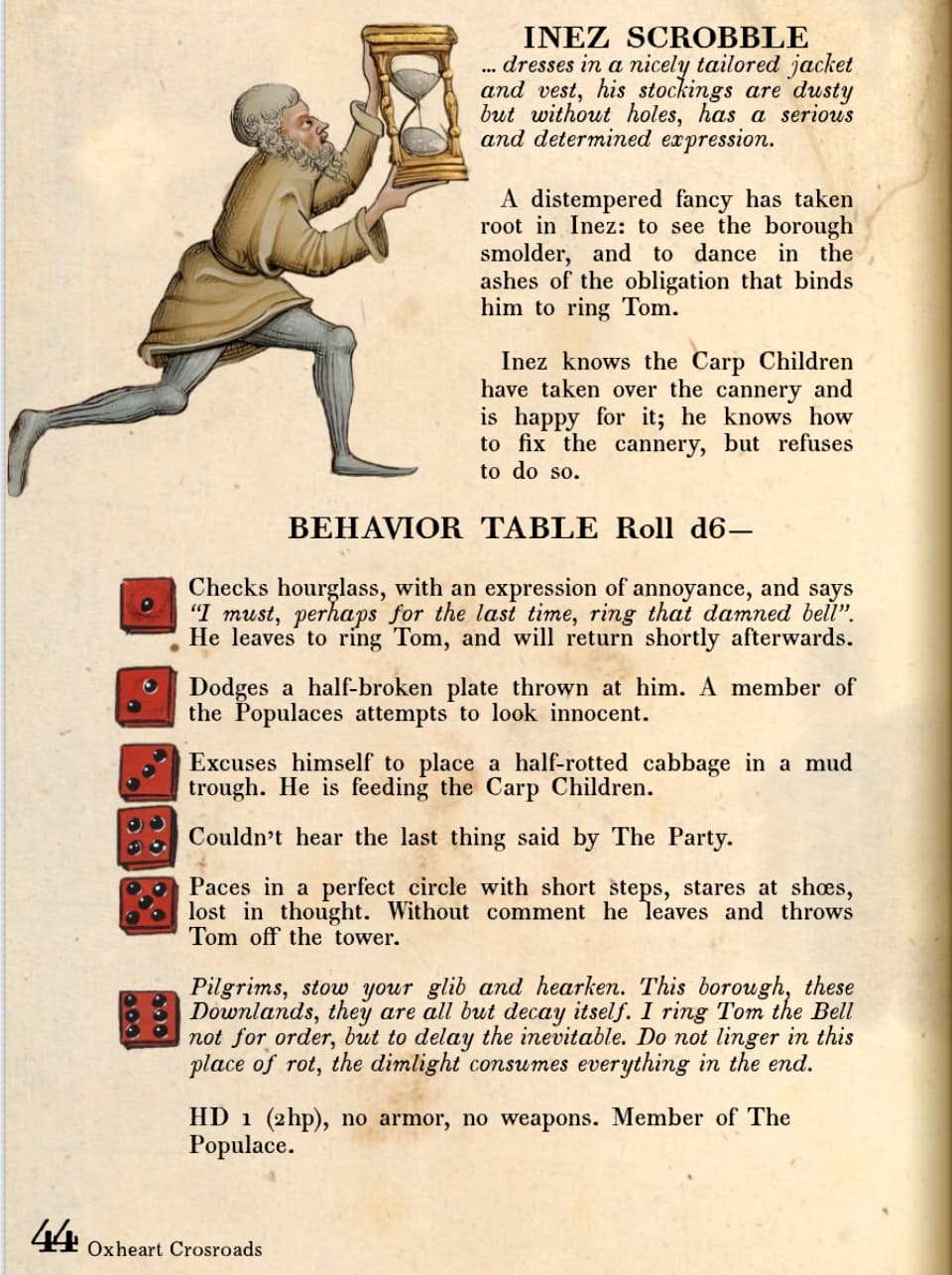
here is my current NPC writing concept. for this adventure, NPCs are pretty important, and talking with them is a pillar of the adventure, getting information etc.
this guy is in the first location you visit, he is supposed to help communicate what the adventure is about (its one of those, you get trapped in a place, and you have to escape adventures). his job is to communicate that this is a bad place to be, and that you should escape. he is supposed to hammer in the motif of decay. he is also supposed to show his alignment with a faction (carp children), to get that faction play going.
my structure:
write a “first impressions”- what characters see from a distance, with hints about who the NPC is. could work as read a loud.
description. info to store in GM brain, help run, help show how he ties in.
behavior table. meant to be read in full, expands on 2 above. also gives concrete examples of how to meet the design goals I have without exposition. GM can roll, or just go top to bottom, or just do their favorite thing.
stat block.
(obligatory apology: I haven’t edited this yet, I see so many things I want to change! inspired by 1000 1000 islands, probably going to ditch the "Behavior table roll d6 thing, its obvious what it is, the dice graphics communicate that. also I want to show that rolling is optional, not obligatory)