Blog book club #16: Gygax double feature

Welcome to this week’s blog club. This week I thought we would look at two posts together, as they are both quite short posts and on a similar theme: Gary Gygax’s immense influence on Dungeon & Dragons, and how the writers respond to that.

  1. Gygax and the old school” from 2008 by Wayne Rossi (Semper Initiativus Unum).
  2. Ich bin ein Gygaxian” from 2008 by James Maliszewski (Grognardia).

Next week we’ll take a look at carousing with “Party like it’s 999” by Jeff Rients (Jeff’s Gameblog), our last post from 2008.

You can see a list of previous blog club posts here.

3 Likes

The first comment on “Gygax and the Old School" captures my sense of the reverence for Gygax, much as I do respect his work: “One of the reasons why OD&D worked was because it didn’t”. Gygax built something that could be good, but it wasn’t inherently good; it just left enough space for you to make it good.

(Nothing but my personal metaphors past this point.)

I think of this in terms of machining tolerances. If something is too loose, its mechanisms jostle and collide, degrading the machine. If it’s tight, it binds up when any unwanted grit gets in.

People think of the perfect machine as the one where all the parts fit exactly together so everything runs identically every time, but in practice the best is often what has space for bits of sand between the gears

Players constantly inject grit into the system. As systems get tighter and/or more complex, they tolerate less human chaos. It’s a tradeoff between strong support and strong restrictions.

OD&D had relatively wide tolerances in a very simple machine. It let you add to it without breaking down, but if you didn’t add to it, it was often lacking. It was a good start, but people kept modifying it because it was often lacking. (I have only minimally played OD&D, so this is not based on a lot, more just the vibes it gives.)

AD&D started adding more rules, making a larger system, but did little to tighten the tolerances. The system bound up on itself a lot, making for an often janky play experience, but a single problem didn’t derail the whole thing, and various house rules rarely broke the system.

3e tried to solve the issues of binding up on itself by tightening the tolerances, preventing rules from conflicting. The game ran smoothly, but when its rules bound up it was harder to fix than AD&D had been, and it had such tight tolerances that expanding it caused issues.

OSR feels like an effort to move back towards those looser tolerances of OD&D, but often ends up with the same AD&D cruft that made that game bind up in play.

(I never played 4e.)

5e went back to looser tolerances and more space for people, a strong move back towards OD&D, along similar lines as OSR work, just less aggressively.
I agree with a lot of what these articles say. Gary Gygax was one of the people who kicked off my favorite hobby. I respect and admire that. The game grew into its own thing once it was out there though. He could “feed” it by providing new rules and source books but so can everyone else. He can say you’re playing it “wrong” if you don’t listen to him, but he can be wrong. I also wish people like Dave Arneson received more of the credit they deserve, but Gary did serve as the “face” of the game for so long.

Compared to films, video games, or board games, every person who plays TTRPGs has a greater say at what they are. We read the words of the designers, but at the table those words only go so far. We can outright refuse to use some of their rules in our games or change them however we want. We can do this with board games too, I suppose, but I don’t feel the same sense of ownership over them that I do with TTRPGs. Maybe it’s because we bring so much of ourselves into this hobby. We create our characters, our worlds[1], and our adventures[2], which may be beyond what the original creators envisioned.


  1. even if we started with one created by someone else ↩︎

  2. same here ↩︎

2 Likes

One of the things I observed about Gary (via discussions on his mailing list and later while working with him directly) was that he was regularly experimenting with rules, often tweaked them, and sometimes changed what he did wholesale. He was also open to trying other peoples’ changes and additions (even putting some in the 1e DMG without having played with them much, himself). While he argued for greater consistency (primarily for convention play and ease in playing at multiple tables), he was open to changes.

He also had reasons behind his choices that he was happy to explain. So, while he wasn’t approaching his designs with an explicit design paradigm in mind, he did approach individual bits with a broad, general take on what made for an enjoyable game. Then allowed for others to play with their own takes adjusting things.

I never got the idea that he thought his take was the One True Way.

2 Likes

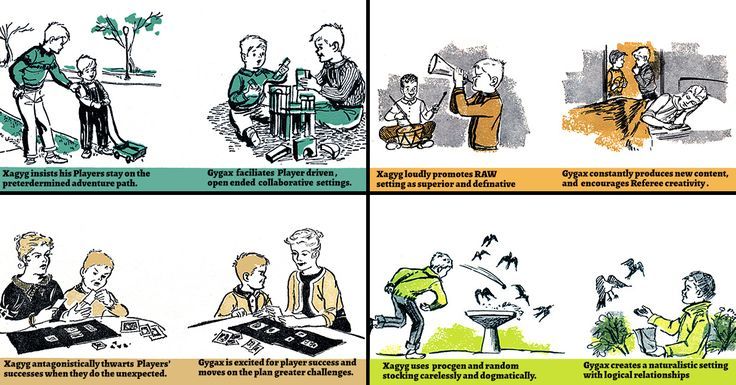
This is one of the places where I disagree rather strongly with James over at Grognardia. I find AD&D to be a kludge of good, bad, interesting and dysfunctional ideas - it strikes me as no more a complete game then the LBBs but with the insistence that it is. For me personally I view Gygax as a split figure - the early designer who wrote in praise of an open hobby and innovation by individual referees (let’s call him “Uncle Gygax” and the marketing maniac who wanted everyone to play only by his rules and piled up weird subsystems to little end except complexity, more brand then man … an entity I call “Xagyg”.

Something like this:

5 Likes