Blog Book Club #29 Into the Land of 1,000 Towers

Welcome to this week’s blog club. Time marches ahead as we enter our last post from 2010, Patrick Wetmore’s “Session recap, 9/8/2010” from the blog Henchman Abuse.

Next week, we’ll tackle “Opening your Game Table,” by Justin Alexander.

You can see a list of previous blog club posts here.

This play report details a session from the home game setting of what would become the partially finished masterpiece Anomalous Subsurface Environment (ASE). This session recap is only the second entry of the blog and was posted about a year before ASE’s first level was released in 2011.

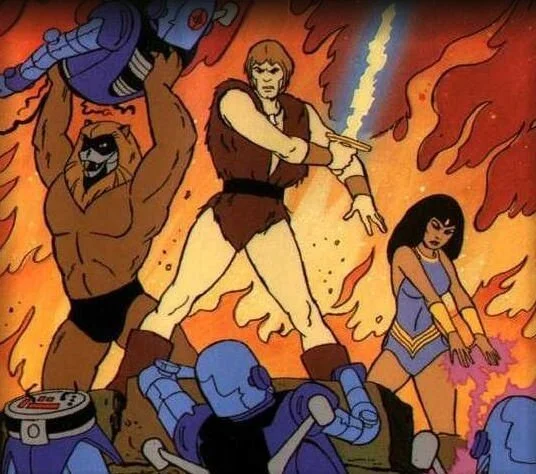
This post is an example of how some bloggers constructed their old school settings. There’s a mix of familiar D&D tropes flavored with fiction the Game Master is passionate about. In this case, the classic saturday morning cartoon Thundarr the Barbarian and the writings of Gene Wolfe season the Labyrinth Lord rules to create something special.

What I find amusing about this play report is despite the rich original setting, in my mind this is indicative of many early campaign sessions I’ve played or read about. Tavern meeting? check, Caravan ambush? Check. Player Character getting killed and replaced with a carbon copy? Check. Over exposure to these elements turn some people off of classic D&D, but I find them charming.

Reading through this post, I was reminded how similar it was to the first ongoing campaign I played in. I was struck by how little effort it would take to recreate the events of this session by reskinning the fifth edition starting adventure “Lost Mine of Phandelver” with strategic placement of “Moktars” and “sick rocks” and chucking most of its prescriptive instructions and weak connective tissue in the bin. Perhaps someday I will do just that.

Want more ASE? Apart from buying the product and exploring more Henchman Abuse posts, another valuable resource is Gus L’s old blog Dungeon of Signs. Back in 2012, Gus L wrote a review for the first level of this megadungeon along with many supplemental play reports, adventure sites, and play aids.

Overall this is a good reminder for me that a campaign can grow well beyond a somewhat cliched starting point. Have you ever played in this iconic setting?

2 Likes

I’m not familiar enough with ASE to comment on that part. What strikes me here is how small the party is — just 2 PCs! I’ll have to read more of the session reports to see how that influences what sorts of adventures they have.

Ah! Immensely helpful context. I knew I recognised the blog name! Otherwise I was really confused as to what made this post so significant in the “canon”.

I made myself a rule of only buying a new megadungeon module when I finished reading the one I already owned. But I’m increasingly convinced I will never run Stonehell, and ASE is top of the list to read next…

2 Likes

It feels a little weird to read only a single post in a series like this (though I may read the rest of the archive some other time).

I like ASE (and its name) and would like to see it finished. My favorite settings aren’t bog-standard fantasy. Give me something with a twist, something weird, or something gonzo. Science fantasy is good too.

The main reasons I think ASE and these play reports are so influential is because not only do they represent a very good and long running insight into one approach to OSR play, but they show the way the “high OSR” of the blog era started to bend setting and expectations. ASE is not a vernacular fantasy world, but it manages to connect to many of the D&D staples (elves, dwarves, goblins etc) in a very interesting way, and one can see the evolution of this throughout the play reports. The Land of 1,000 Towers becomes increasingly science fantasy and gonzo in the proper way of being deadly serious and coherent for the characters but goofy from the players’ standpoint.
There’s a lot of other useful and interesting things in Wetmore’s play reports - the party grows, the game changes, and the dungeon gets bigger and more interesting as it does. I also note that ASE has sprawling levels that are enabled by digital tools in a way that is at odds with early design, but very interesting compared to OSr megadungeons of the same era such as Stonehell and Dwimmermount.

4 Likes

“sprawling levels that are enabled by digital tools” — would you mind elaborating on that a little? I think I understand what you mean, but I’m not sure.

1 Like

This context is really helpful and interesting, thanks everyone who chimed in. I read the post a couple times and couldn’t figure out why it made the list. So I went to Marcia’s own list (from which the book club draws) and saw the post described as “An early example of non-standard (i.e. non-Gygaxian) settings being employed in old-school campaigns.”, which also confused me, since I figured there must have been loads of interesting campaign between the origin of of hobby and 2010, even in “old-school campaigns”. I guess it’s most interesting in the context of this “blog era” period?

1 Like

I expect the claim is in reference to being early in the OSR era, which was only a couple of years old at that time. So, while there undoubtedly had been many a non-standard fantasy setting in the years since the publication of OD&D, the context of the discussion is on the OSR movement and the blogosphere supporting it.

1 Like

You’re absolutely correct. Lots of science fantasy games go way back and has pretty much co-existed alongside D&D through its entire history. Early posters and campaigns within the OSR were playing all sorts of stuff, we even have folks using the world of Oz as a setting long before Koelb, and folks are mashing jedi and star trek into stuff as one would be expected with nerds.

2 Likes

I mean that Wetmore’s maps are big - they don’t fit on 8.5/11 pages and he was able to do this largely by drawing them digitally, freeing his design from limits of a page, something that few OSR mega dungeons managed.

2 Likes

Now I’m having flashbacks to the ‘80s and using packing tape to hold together the four sheets of graph paper that made up our massive 17x22” megadungeon….

3 Likes

time to get a trapper keeper

1 Like

I’m working on mapping a setting of mine for release into the wild and have decided that using multiple small section maps is preferable. The giant maps of yesteryear, despite their cobbled-together glory, just aren’t really desirable.

1 Like

You are not wrong, about either their past glory or their current desirability.

1 Like