Welcome to this week’s blog book club. This week we are discussing “The Sandbox Triangle,” by John Arndt, Dreams in the Lich House
For next week we’ll be reading “The Quantum Ogre,” Courtney Campbell from Hack & Slash.
You can see a list of previous blog club posts here.
—
In preparation I also read‘ ‘Sandbox versus the story’ which is the preceding day’s blog post. That post explored the importance of sandbox play in OSR games. It attempts to plot popular roleplaying games on a two axis chart based on heaviness of rules and the degree a game is typically run in a sandbox like way. The theory discussed that character complexity and plotted story elements both diverged from old school play. That exploration didn’t end up working for everyone in the comments.
So Arndt revisited the issue with this week’s main post exploring what a sandbox is. Two definitions of sandbox are given: as a campaign structure and sandbox techniques for how you run said campaign. What they had in common formed the Sandbox Triangle. Sandbox play is achieved by adjusting levels of player freedom, GM effort and world detail, until an ideal point is reached. He also discusses the need to have a timeline of events which are occurring parallel to the players actions to keep the world from feeling static.
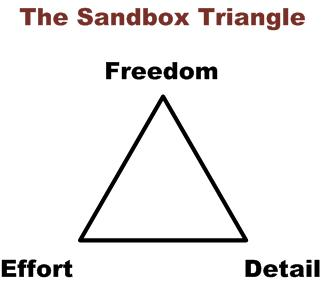
I believe I’ve settled on an example of the sandbox triangle from my own experiences. A few years ago I was running a type of sandbox set in Forgotten Realms Sword Coast. After the introductory area, players could go anywhere and do anything on the western half of a North America sized landmass until they uncovered threats and clues that would lead them to more prescribed missions. This was a structure I was familiar with due to Bethesda published RPG video games where players are free to roam around until they uncover critical plot-related locations. This does not mean that such a structure was easy to emulate. Because Dungeon Masters are not blessed with the memory storage or consistency of computer programs, I was lurching between sides of the “sandbox triangle” every few months.
Areas included in the official adventure were detailed, low effort but severely limited freedom to my players. When players were traveling the continent in “free roam” it gave them a greater degree of choice, but the world I presented felt very superficial and lacking in details as play zoomed out of focus until the world became a series of dusty trails, near identical Inns, punctuated by random encounters. I would frequently create my own content or adapt other adventures to create detailed areas players might choose to explore but this was a high degree of effort on my part.
Due to these experiences I think a lot about sandbox size and density of playable experiences. While it may change in years to come, currently I am drawn to smaller, denser areas of play that ultimately sacrifice the freedom to “go anywhere” for greater degrees of detail and interconnectivity. Products like Dolmenwood, Valley of Flowers, and Evils of Illmire highlight the types of experiences I’ve been trying to curate. In short: I like to run sandboxes, but I’m done playing at the beach.
Do you find the sandbox triangle to be true in your games?