Welcome to this week’s blog book club. This week we are discussing concepts appearing in ”Toybox Style Play,” by James Raggi from the Lamentations of the Flame Princess Blog.
EDIT: You don’t need to actually visit the above blog post this week if you don’t want to support this creator. If for historical reasons you still want to follow along with this project, I have summarized the text of the original post below and presented an alternative blog post by Gus L. as a replacement. Please check out Jewelbox Design.
For next week we are reading a pair of blogs “Simple Hunting” and “Simple Foraging,” by John Laviolette of The Nine and Thirty Kingdoms.
You can see a list of previous blog club posts here.
This week’s blog is brief. It details something that has become a hallmark of OSR style adventure design: environmental interactivity. Or put another way problem solving which is decoupled from combat or socializing with NPCs. When I was designing in the space of trad style games there was sometimes quite a bit of hand wringing over solving the matter of exploration and finding the right game play mechanics to represent exploration. What me and my friends were forgetting with our discussions of wilderness feats and ranger builds is that RPGs are a game of make believe. Someone describes the world and the others react to it. Presenting a world interesting and fantastical enough to engage interest seems to be the challenge before referees today.
The blog post assumes familiarity with B1: In Search of the Unknown by Mike Carr. For those unfamiliar, room 31 of the dungeon contains 14 pools with assorted liquids ranging from useful to deadly; mundane to extraordinary. Players could waste quite a bit of time (and thereby have a satisfying session) by experimenting with the various pools and learning how to best utilize their contents as another resources in the Dungeon.
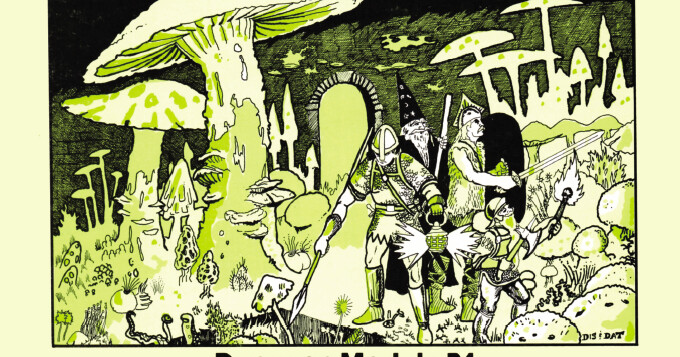
Other parts of this dungeon highlighted include a massacre near the entrance can be used as environmental storytelling so that enterprising players can piece together a place’s history through interaction with clues and forming their own suppositions about past events. Another example listed is books within a closet that help the world feel more lived in and give players potential secrets to uncover. The gist of the theory seems to be that the more detailed an environment is potentially the more interactable it will be. Supposedly, long descriptions of a bat cave will signal to everyone in the game that there is more here to explore.
In my DMing, I’ve found there to be two limiting factors. How much information I can take from the text and recall at the table, and how much information can the players glean from my descriptions. Part of the obsession over formatting in adventure design is that too much detail can be as bad as too little if presented with an overload of information. Each group playing the game has to try and find their sweet spot, which can be like hitting a moving target.
The blog details other classic modules and contemporary OSR adventures which involve situations such as Finch’s ‘Spire of Iron and Crystal’. I find Raggi’s take on this blog post interesting because out of the adventures of his I’ve read, exploration of the environments is perilous enough to make me want to avoid interacting with hostile conditions that could warp and destroy my character from mucking with forces beyond comprehension. But for other people that’s just par for the course for playing this type of game, I guess.
Reading this week’s blog, I was reminded of another blog post that in my opinion takes some of the ideas presented above and constructs a adventure design paradigm out of them: Jewelbox Design and Broken Bastion by Gus L. While Raggi’s post talks about how Toybox play is incorporated into any good OSR adventure, the Jewelbox play is partially about shrinking down a dungeon to primarily focus on interactive and novel environmental game play.
Do you have any favorable memories of sessions created from characters poking and prodding at interactive elements?