Welcome to this week’s blog book club. This week we are discussing a series of short posts “Simple Hunting”, “Simple Foraging,” and ”Quickie Dice Tool v2.0” all by John Laviolette, The Nine and Thirty Kingdoms. These are the final blogs on our list from 2011.
I’ve changed plans for the next blog post a bit because frankly I didn’t have very much to say about quick tables and we have plenty of posts to explore.
Next week we’ll be reading a verified classic post: Crawling Without Hexes: the Pointcrawl by Chris Kutalik.
You can see a list of previous blog club posts here.
Part A: Hunting and Foraging
The beauty and simplicity to this system is rolling a d6 once then spending enough time (each unit of time spent searching for food adds +1) until the die result is more than 5 or the player gives up. I enjoy how this system modifies the initial roll rather than allowing a string of rerolls. I suspect that the d6 roll is hidden from the players so they don’t know how long until gathering food pays off.
For hunting, the size of game the player is looking for determines the amount of time to track down the type of beast you are pursuing. The only thing I find objectionable is the idea of using dungeon chase rules to stalk things like deer. Without the right engagement from players or GMs this could be tedious and I’d probably just abstract it. Results may vary.
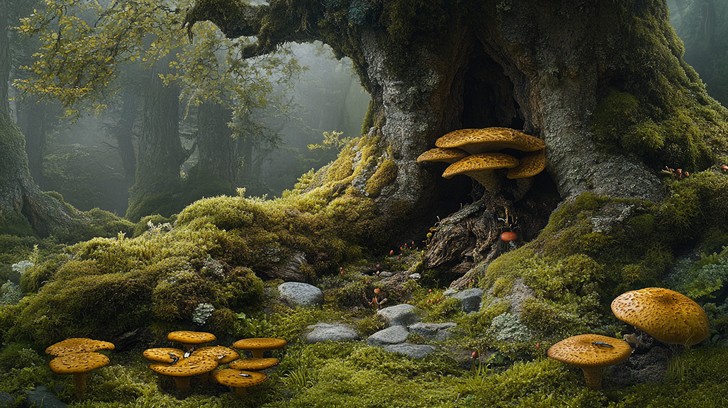
In the next post, foraging, the amount of edible plants and bugs in a biome is the limiting factor rather than size of their quarry for how long this process takes . Rather than working out the logistics of catching prey, the snag with foraging is that there’s a possibility that the adventurers may collect food unsafe to eat.
Overall my main questions on these posts revolve around how much a party cares about collecting food and my own curiosity of how these systems would integrate with wilderness encounter rolls. Descriptions of ‘finding food in the wild’ in the Dolmenwood Players Handbook (p. 154) show how these types of rules are still alive and well.
We’ll revisit these mechanics later in the blog series.
—
Part B: Quickie Tables
Now I am going to address Laviolette’s quickie tables briefly. For me, they highlight a couple of things. The more complex something is, the harder it for me to understand its function: the uses of a spoon are more immediately apparent than that of multitool. Second, the needs of someone who regularly uses a tool every day are perhaps different from those that only occasionally need one. So by creating content generation tools that are highly efficient and versatile, the result can be equally confounding to outsiders.
The project appeared to start back in July of 2010 as two related d20 tables. One that covered “People, Actions and things” and a Second that covers ‘Monsters, Events, and Places”. I kind of like these. I can immediately recognize the purpose of these tables, what type of dice I need, and the kinds of results I might get from them. Even these have a trick though in that each result line has both a normal result (clear) and a so-called ‘ more exotic’ result (shaded). Where this series loses me entirely is the 2.0 version and beyond. If these tools are helpful to you, great! Refereeing is hard work and we should all have tools that help us. This one just ain’t it for me.
When you purchase an RPG product you want that product to for its function to be apparent or to come with a decent set of instructions. A series of increasingly byzantine tables released for free online? Go nuts, someone else on the internet is bound to get it.