Blog Book Club #40: Making Encumbrance Work!

Welcome to this week’s blog book club. This week we are discussing Making Encumbrance Work by Nick L.S. of Papers & Pencils.

Next week we’ll be reading a post from Johann Out for Blood: My Trinity of Old School Gaming (Part 3). I will likely reference other posts in this series as well.

We’ve made it to 40 famous blog posts and have many more to go! You can see a list of previous blog club posts here.


This post spun out of some other ideas Nick was noodling on such as travel and tinkering with Pathfinder RPG systems he was dissatisfied with. I don’t have the mental energy to look up rules from Pathfinder, which is why I don’t play Pathfinder. But Nick briefly summarizes how carrying things work in that game.

I would say the question of how much stuff we can carry does sort of cut to the core of how simulationist a game we are playing. Somewhere between extensive catalogue of inventory and weight, and entirely handwaving what PCs carry there exists game play mechanics that present players with choices and trade offs without all the hassle of realism. This post explores one way of handling encumbrance.

Photo: The Crucible (1996)

Like the majority of people who start their RPG journeys I did not always see the value in encumbrance rules. By playing in some of Gus L playtest dungeons and hitting the blogs to learn, I have come to appreciate that logistics is a very important part of an old school dungeon crawl. Figuring out which life saving items must go into the dungeon while allowing room to carry out that precious precious level raising loot is a satisfying gameplay loop.

I would add as an aside here that I have a personal hatred of bags of holding. They just seem like throwing up our hands and admitting to having encumbrance rules too poorly designed to bother with. When every party deems this object as necessary, that means the magic is dead and it ceases to be something special. I would rank them lower than +1 swords which I can at least reflavor in interesting ways. But they likely proliferated in D&D as a way of at least explaining how adventurers always had the exact item nobody was tracking that they needed on hand. Some jerk like me likely invented its antithesis, the bag of devouring.

Back in the original post, Nick examines the major reasons why we should have an encumbrance system:

  1. It determines the speed of when players arrive at a destination. This is true, but I feel like this doesn’t usually matters much. In most OSR systems I have seen the optimal choice leaning toward loading up and players forming a caravan when they have the wealth to do so. Part of this is the amount of gold in these games makes slots valuable but items largely replaceable. Changing assumptions about resources or competition in the wider world would likely make travel speed more or less important.

  2. Nick notes that “Returning to a dungeon to retrieve the piles of gold they were unable to carry can be an adventure in itself, requiring them to face unique challenges such as getting a large cart through the wilderness." I have recent experience as player to share! In one of my games the party hired goons to pull vast sums of currency from a sunken library only for our mule trian to be ambushed by rival adventurers on the road back to town. The incident wiped out the PCs present during this session. Now the remaining characters are recruiting new PCs and planning a revenge mission. This saga would not have happened had we simply been able to carry all of the treasure out of the dungeon with us the first time. As a result the game world feels more satisfying and lived in.

  3. Base building grows organically out of encumbrance needs. Once gear is important having a secure place for it becomes essential. I don’t have much experience in this vein, but I have always wanted to test out the base building rules in Free League’s forbidden lands.

Later, we get Nick’s Encumbrance house rule:

  • Items are judged to be significant by asking whether the item in question should count toward the total number of permitted items. “a significant item is any item which is heavy enough, or large enough, for the character to take notice of its addition to their equipment.” Insignificant items are bundled together to form 1
    *Scores of 1 are assigned to regular items and 2 for bulky items.
  • The encumbrance number is tallied and compared to the PCs strength ability score. I am rusty on pathfinder so I assume it will be typically in the teens and can be raised into the twenties.
  • Carrying items that double the strength attribute drop a characters speed by a quarter and impose physical penalties, carrying items that are triple the strength score reduce speed by halve and increase the physical penalty to rolls made.

I appreciate that Nick mentioned that realism is not the goal of these rules, instead they are about getting players to make choices that will impact the game.
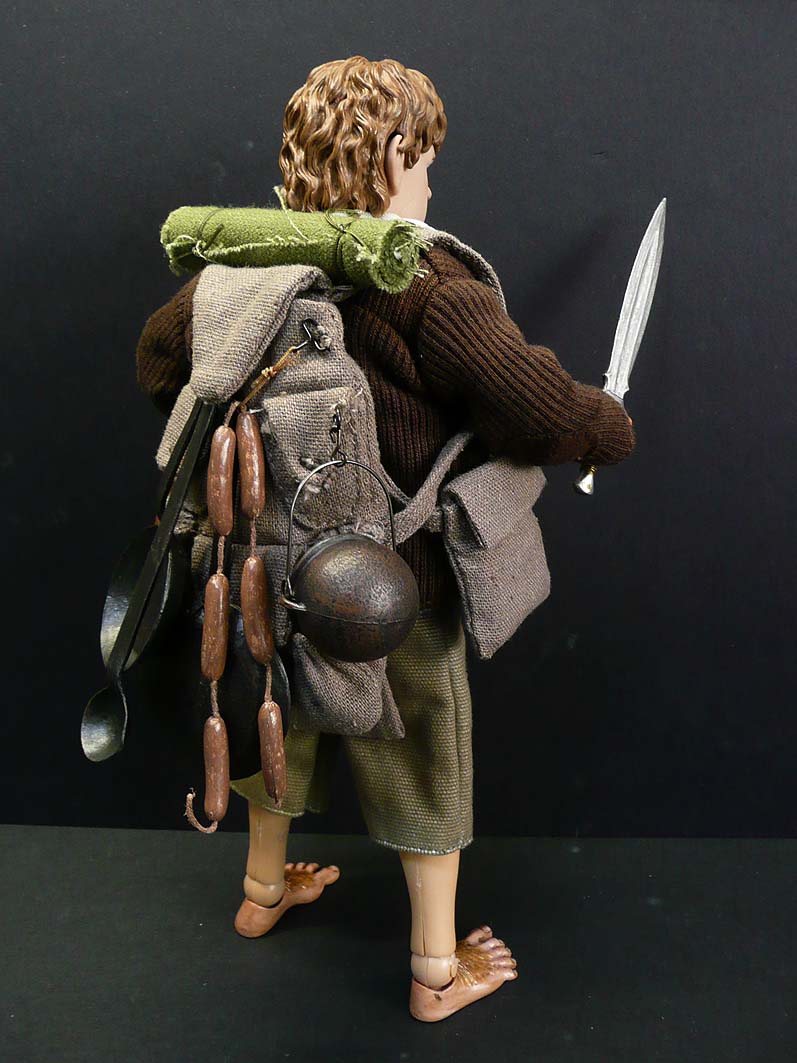

photo credit: toyhaven blogspot

While the word “slot” does not explicitly appear in this post, I would contend that this is a slot based encumbrance system. And by OSR standards it appears to be a fairly generous one at that! (you likely need more stuff in Pathfinder). Through my sampling of the OSR I would say the primary difference between such slot based encumbrance systems is how many slots you have to work with and whether your attributes (typically strength) affect this score. Occasionally the speed at which you can retrieve stowed items also matters.

A brief Survey of Slot Based Encumbrance in Popular OSR Systems

  • Into the ODD: Items are bulky or minor. Overall encumbrance is handwaved but characters speed and hit protection drops to nothing if they are carrying more than 3 bulky items.
  • Cairn: 10 slots (6 of which are stowed in backpack)
  • Knave 2nd ed: 10 Slot + CON Modifier.
  • Vaults of Vaarn: Slots Equal to Con defense score (min 11)
  • OSE / Dolmenwood 3-9 equipped, 10-16 stowed (sliding scale of penalties for encumbered PCs)
  • Shadowdark: Equal to Strength Score w/ a 10 slot Minimum. Fighter characters can typically carry more by also adding their con modifiers (Also: this system is more generous than it first appears because many class specific items are handwaved.)
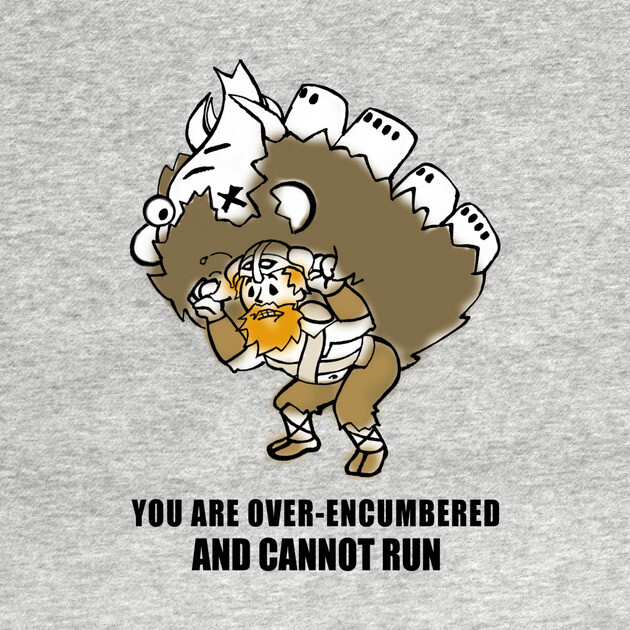

photo credit: Chentzzilla design on Teepublic

For people who do not have a good slot based system and would like to look at a published example for a BX adjacent game, I would point them to Old School Essentials Zine ‘Carcass Crawler Issue 2’ (pg 28-29) or Dolmenwood Players Book (p 149).

Final thoughts:

  • Enforcing encumbrance systems makes the prospect of hirings more attractive.
  • The existence of slots makes GMs want to design items good enough to take up a regular slot without becoming a ‘go to’ or game breaking solution. I enjoy mechanics that throw down the gauntlet to designers.
  • The weight of treasure vs its value becomes an important factor. Gems are light! Art is heavy. This adds texture to a game.
  • There will likely always be some amount of awkwardness that is dissatisfying with encumbrance that cannot be remedied. But if we can get to a place that supports player choice with minimal friction in the majority of instances I think you have a working inventory system.

How do you and your players carry your stuff?
1 Like

I did a Rules Reference/Play Example on Encumbrance for OSE and B/X. It’s one of those things I often see newer Referees struggling with or the knock on effects of ignoring it creating issues at a much later point in time.

I’m obviously a fan of it leading to those meaningful choices and am happy to get as granular or abstract with it as necessary to meet the needs/desires of a given Table. In games where Treasure is XP, I find that a lot of times the Players actually do a lot of the tracking for me (they want to know how much XP and wealth they’ve acquired!)

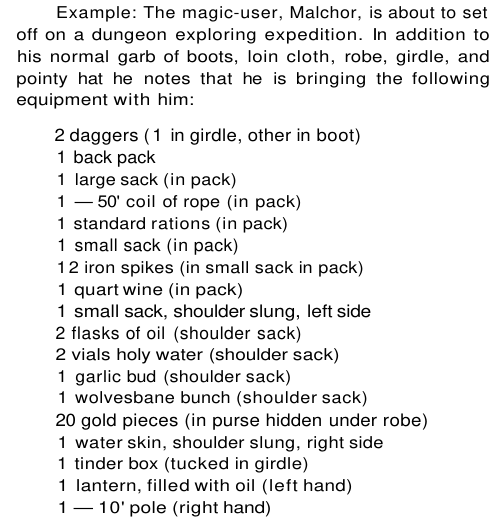
While we’ve messed around with Slots before (and I even included them in my Equipment Encumbrance Rosetta Stone that doubles as a handy “d100 Pieces of Gear” table) probably my favorite “System” these days still harkens back to my first exposure to Encumbrance in the Holmes Blue Book: Write down your gear, but also make a note of where or how you’re carrying it. I think this goes a long way to grounding things more in the fiction, and let’s us have those occasional sanity checks about whether or not something can be acquired, where it can be stowed, and just how much of a burden it might create for a Character. Good ol’ Malchor:

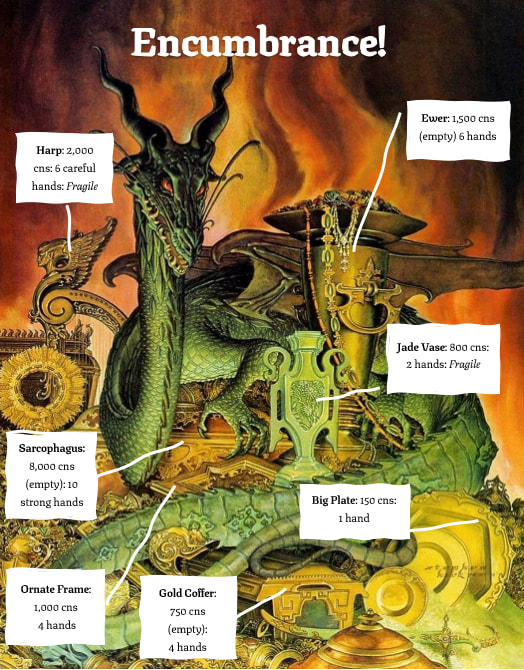
For other games, I’ve also produced visual aids like this one to share with the Players and stress that some Treasure is more about the number of free hands than it’s actual mass/weight/slot value. This can often turn hauling it out into more of a logistical puzzle or something that requires the Party to go and acquire Help to solve. Taking up those “Hands” often discretely limits options and outlays.

5 Likes

One of the interesting things to me about this post is that it’s an example of one of my friend’s and collaborators journey into OSR and now POSR design. Back in March 2012 I hadn’t started blogging yet, and was just starting my ASE campaign. Yet here I see NIck and Brendan of Necropraxis (in the comments) discussing the idea of significant items. This idea became a part of the overall slot encumbrance discourse and I’d become friends with both of these guys (along with Ram of “Save vs. TPK”) playing in Brendan’s Pahvelorn campaign late that year.

This is part of the around the birth of the G+ OSR, and it has a surprisingly small cast of characters, at least for me. The specific post and idea here is Nick wrestling with his Pathfinder dissatisfaction, just as Brendan was as well. The branch of OSR folks who were discovering old systems for the first time from the same wellspring of annoyance at the complexity of 3.5E/Pathfinder etc. However aside from personal nostalgia, I think this post is interesting as I hadn’t realized Nick was the source (or a source?) of the “significant item” discussion - which is a subsidiary rule necessary to make slot encumbrance function. This is still a going concern/discussion in the post-OSR, yet here in 2012 it is also being called a “solved problem” because of the “stone” system which I associate with LotFP. I disagree with the “stone” folks, as its a purely weight based, and exacting system that just uses antiquated terms for measurement… Anyway encumbrance methods are between a referee and their personal vision of the divine…

What I want to get at here is two fold:

A) The recognition that encumbrance is a key rule/subsystem for dungeon crawling/old school play
B) That this post is a great example of the way blogging and rules consensus accreted or built up during the OSR and especially the G+/blog OSR era.

Nick’s terms and some of his ideas were discussed, and used in G+ games … “significant item” enters the OSR lexicon. It’s a tiny thing, ending one small objection to solving encumbrance through simplification/slots, and a collective, community process of adoption and shared insight/knowledge that utilizes it. Not an individual auteur’s product.

Before I go on to long - I also think encumbrance is one of the big problems of classic D&D… the treasure/XP system and the coin based encumbrance system make for a time wasting and frustrating set of rules that just doesn’t work well … and AD&D’s efforts to rationalize it through STR score and pound weight only make it worse. I am of the personal opinion (at least when I drink enough rum and start making strings maps on the corkboard…) that the poor encumbrance rules are a big part of what pushed D&D away from dungeon crawl style play. Anyway…

2 Likes

One of the things I’ve long found missing from rules surrounding encumbrance is rules for carrying items in hand, for carrying large bags, chests, and making travois to carry stuff. Then anything about dropping what’s being carried or dragged when needing hands free and recovering it later if the PCs had to flee. Systems seem to assume that PCs will only carry loot in their backpacks. Even hirelings seem to stow everything they carry in their packs. WTF?

Carry goods in hand makes for more interesting challenges. Need to cross a chasm via a rope and half the loot is being carried in hand? Yeah, a different proposition than if everything fits neatly in the pack.

I don’t think an encumbrance system is even complete until hand-carrying and chest-dragging and “how do we get this across the gorge?” is considered explicitly in the rules.

1 Like

Something like Rotten Pulp: Morgan Brackish Meadows' Anti-Hammerspace Item Tracker ?

1 Like

It’s interesting to note that, a few years down the road from the article (2012 to 2018), Forbidden Lands ended with a very similar approach (slot-based encumbrance; two-, one- and half-slot items; insignificant items), plus offering a solution for the consumables issue through usage dice for food, water, torches and arrows.

As @GusL mentioned, I believe in this case the addition of usage dice is another instance of a small patch over an old objection. Maybe this article had something to do with it. Maybe it was The Black Hack and its usage dice. Maybe it was an original idea that converged with some already existing solutions. We’ll never know.

For me, I find a system with slots and degrees of penalties a bit too much, but that’s just a matter of preferences. I think the abstraction of slots aligns better with an absolute and simple limit for carrying capacity.

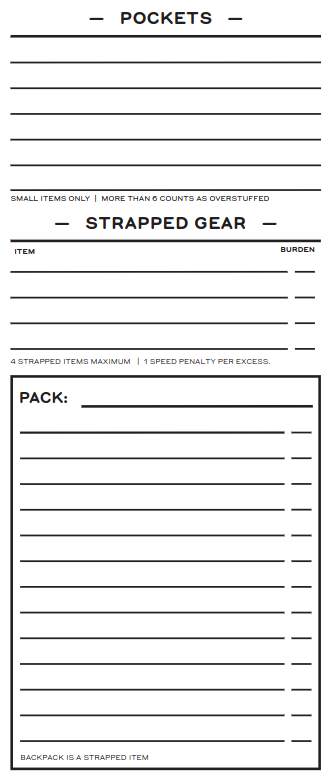
I’ve been reading the Incunabuli rules recently. They tend quite fiddly as per the author’s own preferences, and this extends to encumbrance - their full rules involve tracking weights, I believe. However, I thought this extract from their character sheet was a nice way of thinking about where gear is stowed without getting too complicated:

As you can see you can have six small things in your pockets, a few larger things (like weapons) strapped on to your person, and then everything else has to go in your pack. Note that the pack itself is one of the 4 things strapped to you. It takes an action to get things from the pack, whereas the pockets and “strapped gear” are free actions. Pretty nice!

Also, @Barnum:

:joy::ok_hand:

I’d always made notes about my PC loadouts so I knew if something was in a backpack or a belt pouch or pocket in a vest or wherever. It wasn’t until I read that the first time that it clicked that many people *didn’t* track placement. D’oh!

That’s why I keep looking at slot-based systems in the hopes of finding one I can fully enjoy. I know I’m going to end up with a slot-based approach in my projects, with only the details to be worked out.

And I’m going to address carrying extra loot and dragging chests and all that, too. Fill yer bags then fill yer hands–ya wanna be rich, don’t ya?

1 Like

The most fun I’ve had with this in recent years: we used item cards for anything held in hand, and all the players had to put their 1 or 2 currently held items in front of them on the table where we could all see them.

So if a player picked something up you could immediately see the fictional problem with it, but also you could wordlessly and quickly fix it by literally handing the lantern over to another player.

It’s not necessarily worth having item cards for everything (e.g. a bit of loot that just goes in a sack) but for those things it was really helpful.

1 Like

Oh, that’s cool. I imagine using pencil instead of pen allows those cards to last a good while, too, so dropping loot off in town just means erasing the cards to show empty hands.

1 Like