Welcome to this week’s blog book club. This week we are discussing the Trinity of Old School Gaming posts from Johann of ‘Out for Blood. They are all relatively short and I recap them below.
Next week we’ll be reading A 16 HP Dragon by Sage LaTorra of LaTorra.org.
You can see a list of previous blog club posts here.
—
This week perhaps we aren’t breaking much new ground from things we’ve already raised in this blog book club, however, I think these posts would serve as an ideal recap for someone who has begun exploring the OSR and needs to see how all the concepts are put together.
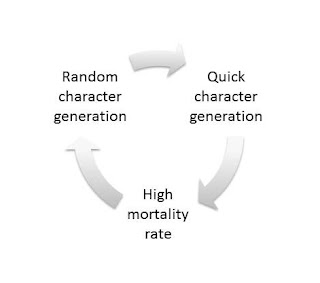
Part 1 in the series starts off with a diagram explaining how Random PC generation is fast!. This in turn can support the lethality of OSR play.
Its noted that in low lethality 1-20 trad RPGs that random generation can lead to player grievances due to be stuck with characters that may be ‘suboptimal’ for years. In games that primarily focus on player skill this is less of an issue.
In Part 2 the diagram is expanded and the text focuses on OSR strengths in combat. While there’s been an awful lot of back and forth in our blog club posts over the last few months as to whether OSR combat is so boring it will incentivize people to avoid it or whether the limitations make it exciting. This post falls on the side of lethality giving combat meaningful stakes.
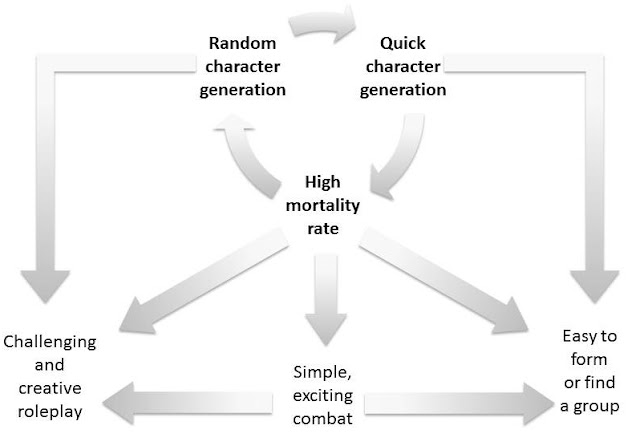
In Part 3 (the entry listed by Marcia B. as a keystone) the points all boil down to that OSR gaming is accessible! You can quickly form a group without a session devoted to making PCs, you can keep them engaged with deadly fights. Part of the fun of random PC creation is discussed. I agree with this take on how people become invested in their weird little characters.
The PCs aren’t characters fully formed in players heads after weeks of deliberation meant for the other players to slowly reveal over time for dramatic effect. Also the PCs are not crafted from rules in sourcebooks you’ve never read. What I mean to say is that all the meaningful development happens right there at the table! I would argue there are perhaps other ways OSR play can be detrimental to character investment… but I would say those are more of long term issues like if a team member dies in a session you missed.
Part 4, the conclusion to the series, explores how OSR changes role playing. Here there is a reflection on heroism and how not being handed easy wins changes how players approach the games. Are the players invested in the danger? Or just the characters?
While it could be argued that D&D games could hypothetically be designed with high stakes but low character lethality, I’ve yet to see it done in a way that doesn’t involve a terrible amount of work from the GM. I’m not sure why this is. Perhaps when something that’s precious as life is portrayed cheaply it ripples outward?
I think the note on genre emulation vs character motivations is well put, but I think it could fall apart after a point. If you adopt a OSR PCs mindset after a few levels under your belt the correct answer will usually be to retire and let someone poorer and more foolish muck around in a dungeon.
Finally, the simplicity of OSR gameplay leaves more mental space for players and GMs to describe how they imagine this world and the actions of the creatures within it. I am all for people imagining stuff together rather than spending their turns flipping through rulebooks.
Reflections
The brevity of these posts is refreshing and I think the diagram is a good visual demonstration of the strengths of the OSR. This series is successful in explaining why its comparatively easy to form an OSR group (provided you can get bodies to the table!).
In trad RPGS before starting a campaign I used to sit down with players, establish the tone of game, walk them through character creation, coach them through backstories. It was a lot of work and the next session we would put on what was akin to a pilot in a longstanding TV show. I’ve come to realize that this puts an incredible amount of strain on the GM and it effectively adds many barriers to just playing the game.
I’m not saying there’s not value and fun in creating longform dramatic campaigns in this way. The Critical Role folks are still selling out stadiums demonstrating this type of RPG play. But for me, I will start a brief campaign next week by cracking open ‘Into the ODD’, telling my players to roll 4 dice to make PCs, and then starting them off at the mouth of the dungeon. Instead of trying to make it a TV show I’ll be treating the session more or less like a one-shot and I’ll give it the space to grow into something bigger.