Welcome to this week’s blog book club. This week we are discussing “On Set Design” by Courtney Campbell Hack & Slash.
Next week we’ll be reading https://rottenpulp.blogspot.com/2012/06/matt-rundles-anti-hammerspace-item.html by Jack on Rotten Pulp.
You can see a list of previous blog club posts here.
___
Today’s post is about dungeon keying!
The post references T1: Village of Homlett but I haven’t had the pleasure of reading it yet. More importantly its about a process of keying information in a dungeon to make it easy for DMs to read at the table.
Some people must love reading long paragraphs and then typing up notes on those paragraphs! That’s good for them! But, it’s not me. I am a sweet summer child grown indolent supping on the terse keys of supplied to me by Necrotic Gnome (and many many others). Looking back 14 years ago this was far from the norm in published modules I was reading at the time. While I am determined to continue on my lazy existence for the time being, the least I can do is examine the struggles of those who came before and appreciate the work that goes into crafting finely tuned dungeon keys.
The post provides some example rooms and then the key is decoded. Then an example of how a DM might interpret that room for their players.
Bolded words! this approach remind me of early text based RPGs. But they are classic for a reason. Expounding on keywords to drill down deeper and get more information is a time honored tradition and if ain’t broke …
I think the hardest part for me was understanding that the items were in a container.
Downside of this approach is I think you need to know the room key if you are new to this. Its not necessarily intuitive, but I don’t think it would take long to adopt either with some practice.
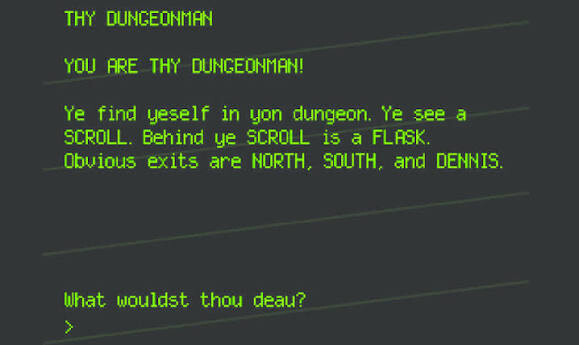
Source ‘Thy Dungeonman’ from Homestarrunner.com
The post references this free resource on stocking empty rooms! (also by Coutney Campbell). While I didn’t get a chance to look at it, it seems like a useful tool to have on hand.
Ultimately, Campbell explains the reason to pursue terse keying is seeking speed, flexibility and creativity. And its undeniable that the room with ghouls, an expensive dwarven chair and a sack containing numerous treasures is highly efficient even though its likely enough to supply full 30 minutes of play on a mere 11 lines of text.
If i had nits to pick here I would question whether the referee not giving any extra words when running the key makes dungeons too spartan. Sometimes I need some inspiration to help me bring dungeons to life. These Key words are peak efficiency. I am just thinking I lack the skill at this point to bring a dungeon to life without including short punchy descriptions in my notes. (but i am not precluding the possibility of having both a dungeon key and supplement it with other types of notes).
How do you key your dungeons?