Next week we’ll be continuing this theme with “OD&D Equipment" by Brendan S of Necropraxis.
You can see a list of previous blog club posts here.
___
In some media there’s a sub-dimensional space where all the cumbersome items are stored off screen until they become relevant to the story, like in a Looney Toons skit where Bugs Bunny has a mallet tucked up the sleeve of his glove. By some, this is known by some as ‘Hammerspace’. This week’s post draws a parallel between hammerspace and RPG games where item quantity and weight may be tracked and recorded, but their exact location often remains vague until it becomes relevant to the fiction of a game.
The post raises the questions of whether dramatic possibilities are lost from not recording the positions of these items. What happens if we create containers for items that exist on the character sheet? The post brings up the possibility that once they take up space, they can be more directly influenced by the settings fiction and could be damaged or stolen.
The post proposes 6 containers that can carry 3 small items or 1 large one. Wearing armor reduces the number of containers available. Overall, while its intriguing, I also think this system is fairly strict compared to other OSR inventory systems I’ve seen.
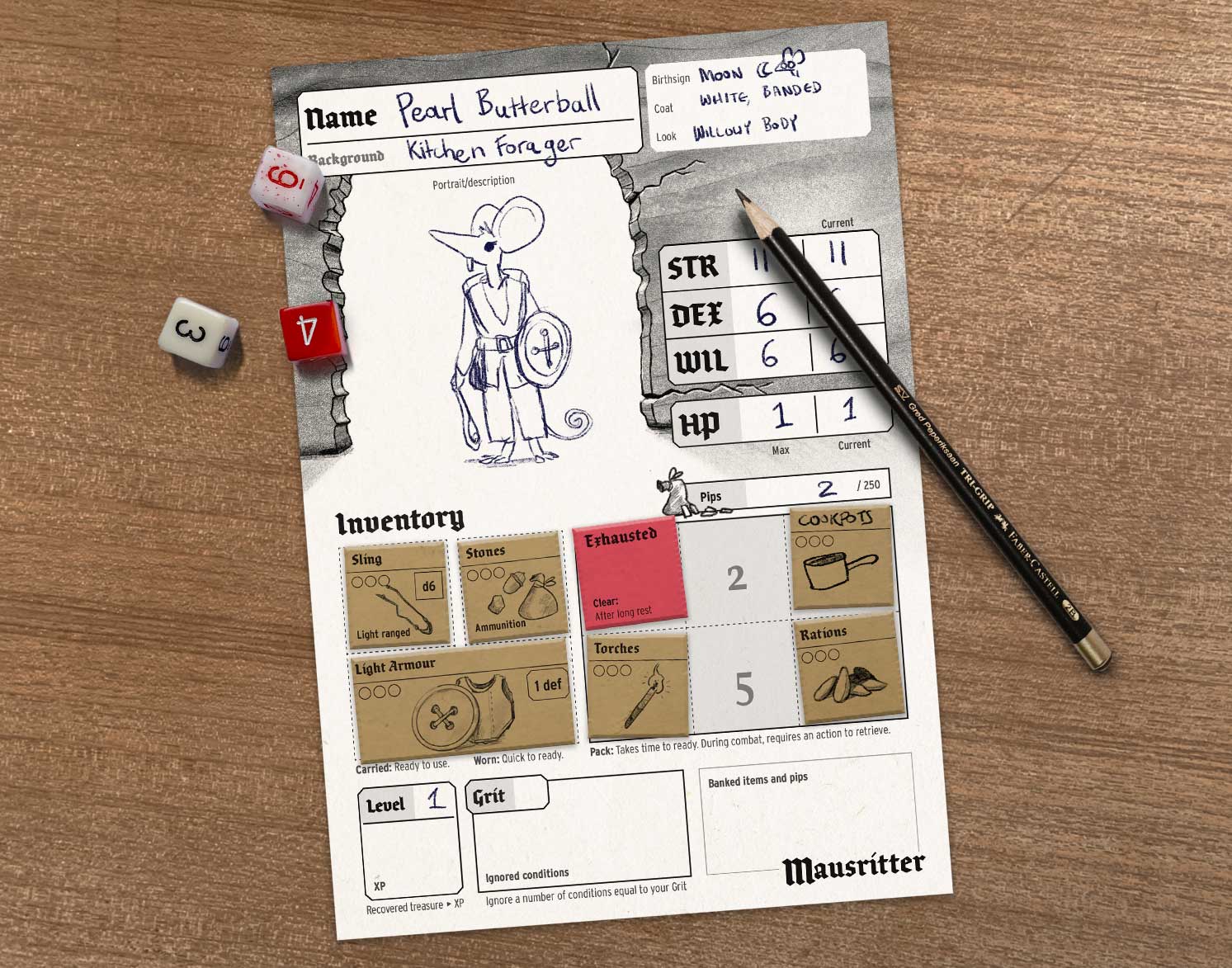
Now what games does this system remind me of? Primarily Mouseritter by visual appearance. On a somewhat similar, but more abstract, way of attacking items in hammerspace is Knave 2e which using item positioning so that items are lost in order when a slot becomes filled in with a wound. Other Games have rolls for accessing items in combat based on item positioning.
I believe the inventory sheet would work fine in larger sized parties or if a group was using hirings to get more slots. I think fighter characters could be inconvenienced by this system the most, especially if it interacted with other rules that would encourage martial types to carry multiple weapons. I just can’t shake the feeling that I would be a lot happier with 8 or 9 slots rather than 4 to 5 (when accounting for armor). Even if I quibble with the methods, I respect the problem this post is trying to solve.
How do you think about this inventory system? Have you used it or one like it before? What’s your favorite way of making inventory feel more like part of the game world?
I really like this post. I do think that tracking the location of gear can add a lot to the gameplay, especially in Cairn when the warden has to describe a “Loss” result on the dungeon or wilderness event table. It’d be much easier to just ask “what’s on your belt? It’s lost/damaged”. You can do this without strictly tracking by asking the players and trusting them, but I know I’d subconsciously go for the least impactful loss when I have to choose.
However, it also epends how cumbersome it is to use at the table, especially when moving gear around. I like Mausritter’s solution with the physical tiles you can move around. I wouldn’t want players to be erasing and rewriting gear as they move it around on their sheet.
I’ll be thinking about this when I set up my next game.
This, for me, explains the appeal of slot-based systems, at least those that require placement in a pack or belt pouch and so on. I think this comes from me, as a player, always writing down on my character sheet where the items I carried were actually carried. What was in my PC’s backpack, what was in any belt pouches, what was in bags strapped on alongside the backpack, and so on.
As a GM, I tracked what PCs were carrying in hand and strapped on for quick access and assumed all other gear was stowed in a pack or bag that wasn’t very accessible. If a player wanted their PC to grab something quickly and it wasn’t in an accessible spot, well, that plan had to change on the fly. Those PCs with blades hidden in their boots, for example, could have problems reaching the blades, so knowing what blades were accessible in the current situation could make for a significant difference in play. The PC might not be able to throw all of the knives carried due to not being able to reach them all.
Clearly slot based inventories were the in the OSR zeitgeist in 2012. This is our third post on this topic now, I think. I’d be interested in an overview of how this has trickled into later design.
I assume all the retroclones (OSE, Labyrinth Lord, OSRIC, etc.) still assume you’re tracking weights in pounds? Do any of them suggest slots as an optional rule? I wonder how many people playing games using those systems (or the original D&D rulesets) use slot based systems as a house rule?
And then the big NSR rulesets: Knave, Into the Odd (and E.B.), Mausritter, Cairn, etc. - which ones use slot systems?
I’m partly wondering: did the OSR scene “solve” this problem in 2012, and if so is that reflected in how people are writing and playing games?
I know I’ve seen lots of takes on a slot system. Many of them are in supplements, however, and I’ve not paid attention to how many are included in base rules for systems.
I’m not certain it can be “solved,” either, as the different approaches require different decisions on part of players, so that’s a good question. What decisions are viewed as important leads to different encumbrance systems. I do now wonder if there’s been a trend in slot systems to coalesce into a “generally the same” approach over the years.
By “solved” I meant: are there people designing new post-OSR games who are choosing to do something completely different from slot-based (e.g. classic weight tracking), or have we as a community converged on some kind of variant of slots? Even if there is a fair bit of variation in what that looks like from game to game.
Knave, Mausritter and Cairn all use slots. I think Into the Odd and Electric Bastionland just limit you to 2 “bulky” items but don’t have a strict encumbrance system for usual items.
I know OSE also has slots either as an optional rule or in one of the Carcass Crawler zines.
I’ve never played any of the older editions or retroclones that use coins or pounds for encumbrance, and don’t think I’d even bother to. Slots deliver enough interesting choices about what you are carrying without requiring a spreadsheet to track.