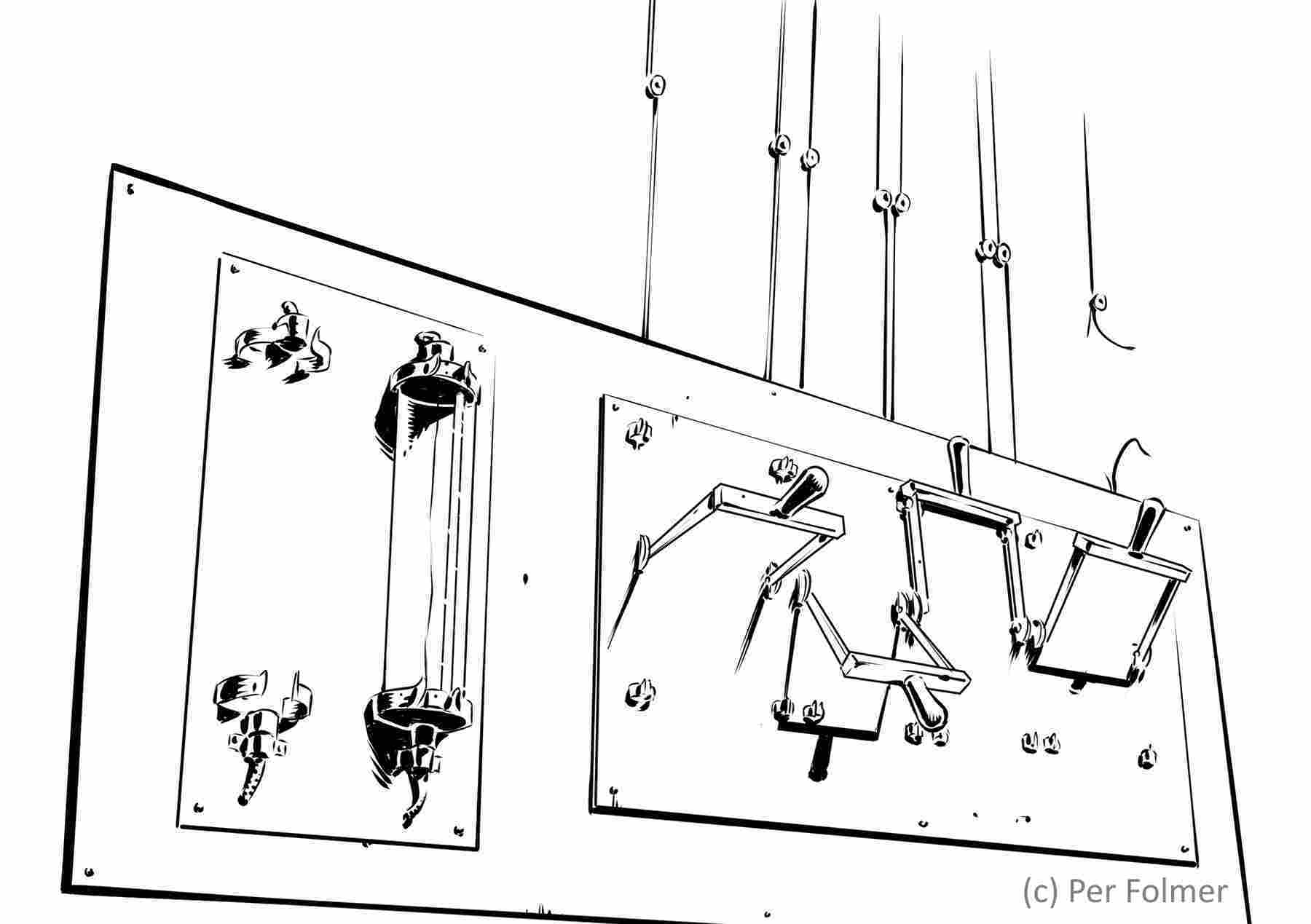
I’m starting to write-up my latest game module. It works well enough, when the PCs don’t get eaten by a giant bird. But there’s a bit I haven’t been able to crack. I’ve got a panel of electronic switches on the wall in the apprentice’s quarters. It looks like this:
The switches control various lights and motors located within the dungeon. I’ve seen two reactions to it: replace the fuse and flip all the switches back and forth a few times (Do we all have a player who loudly plays all of the keys on the duke’s piano at first opportunity?), or ignore it, because it looks overly complex/dangerous (“my character doesn’t understand what he’s seeing, so I’ll just move on”). There are some non- or semi-functional electro-mechanical devices earlier (and later) in the dungeon, so I do try to telegraph some of the potential outcomes.
To make myself feel worse, I’m curious: What is one really goodpuzzle in an RPG module? And, what, to your mind, makes it “work”?
The switches are too many things at once. Repetition is your friend.
There are some non- or semi-functional electro-mechanical devices earlier (and later) in the dungeon
These previous instances should provide lessons for the PCs to learn and apply to the “big” puzzle of your switchboard. i.e. One red switch that controls the lights. THEN one blue switch that controls a motor, etc.
Your switchboard then has a blue switch and a red switch on it. Players can encounter the lessons before or after, but either way they have actionable information to work with rather than just guess and check. Give them a view of the devices that are being controlled, like through an observation window. Video games can pan the view to what the player needs to see. We don’t have that luxury, so throw them a bone.
What is one really goodpuzzle in an RPG module? And, what, to your mind, makes it “work”?
I don’t know which Mork Borg adventure this is from:
There’s a locked door. There’s a statue beside the door that’s missing an eye. The eye-hole has real bloodstains on it.
Solution is to find a fleshy eye replacement for the statue. The real fun is now finding an eye (if you don’t want to use your own).
The solution is not immediately obvious. PCs can wander about keeping it in the back of their minds. They should be encountering many NPCs with eye-patches just to reinforce that this is just how the dungeon works. People offer up an eye or two for the cause. PCs might get the solution right away or might need some time. If they really need to, maybe they will stake out the area and see how the NPCs get through. Many possible options for the PCs to try to figure it out.
Thanks, directsun. I’ve had a read through those posts. Interesting stuff in there.
I like the example a lot as well. There is even room for optional bonus telegraphing of things like “upon closer examination, several of the skulls have their eye sockets marred and scraped, as if by metal tools” .
I imagine I’ll add one of the knife switches early in the dungeon controlling something pretty mundane, then lock something intriguing behind an electro-mechanical lock.
Directsun already gave top-level advice on puzzle design so I’ll give some feedback on this specific puzzle.
It is too complex.
With 4 switches there are 32 possible orientations. That’s a lot of trial and error and it seems like players have no way of determining ahead of time what combinations might not work. When incorporating a switch of some kind into a puzzle you have to keep in mind the combinatorics. How many states does the switch have? These are binary so 2. With n number of switches you get 2^n possible configurations.
Based on the art that you’ve posted I’m not even sure there’s only two positions for each switch! Some are fully engaged, others are half-cocked. These could actually be levers that deliver a percentage of power down the line, at which point there are an infinite number of solutions.
Two easy solutions.
Make it clear in the description and the art that these are binary switches. You could just add a description of an indicator light that is either on or off.
Color-code the wires coming off of the switches, or otherwise label them at the panel in some way. Complex industrial scale machinery is absolutely plastered with warnings and labels. It’s far more important for the operator to understand the proper usage of the equipment than to “hide” that information for “potential intruders” (which, even in the case of military installations, still doesn’t outweigh proper utilization!)
You can have 4 switches, but you need a way for the players to quickly filter their options down from 32 combinations.