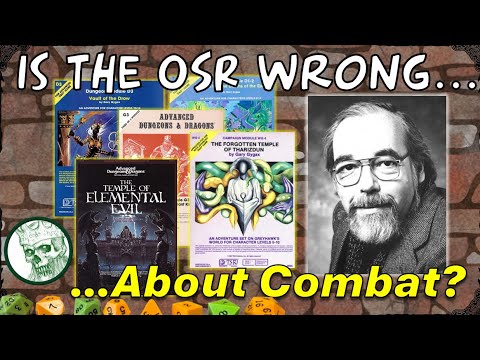
Cool video I stumbled upon today that shares my view on the idea that “combat is a fail state.”
Cool video I stumbled upon today that shares my view on the idea that “combat is a fail state.”
Interesting video! I agree with the premise that there’s tension between the idea of combat is a fail state and Gygaxian D&D, but I disagree with some of John’s conclusions. Gus L has a very thoughtful take on this tension in “7 Maxims of the OSR.”
As for me, I’m becoming increasingly interested in an OSR that’s further removed from D&D’s wargaming roots. Hopefully I’ll find time to blog about that soon
Same, I think some of the conclusions are a stretch, but I enjoyed his exploration and I think it’s good to remind ourselves that the popular dogmas we hear aren’t black and white.
I’m at war with most OSR maxims (I’m in for the mise-en-scène), but also not a fan at all of the whole Sunday School approach, where it’s all about “What did Gygax say/do/mean”? So this video wasn’t really aimed at me at all…
But disregarding the premise, he did make some good points about encounter design. Seems worth doing a bit of personal research into that completely unconnected to the “maxims” argument, so thanks for the link!
I generally don’t mind the people as much who say that it’s a “fail state”, but a big part of the gaming experience is aiming for those. Where it’s not an exercise in hireling-based Excel optimisation or algorithmic dungeon path-finding for optimal no-combat treasure gain 
Where it’s not an exercise in hireling-based Excel optimisation or algorithmic dungeon path-finding for optimal no-combat treasure gain
I love that, lol, and great point.
I agree about the gygaxian Sunday school part, but viewed from a different angle it is just taking two steps back and asking the larger question of what role combat plays in current OSR modules. I think it’s an interesting insight that there seems to be a certain unoccupied design space that leans a bit more into combat as an interesting puzzle premise outside of attrition spreadsheet Maths. To me though that does not lead to the conclusion of converting old modules, but writing something new that spotlights this design space while also upholding all the other lessons we have learned since the 1970s. I can do with a little less Gygax in my D&D these days.
Looking back at the more interesting combat situations I’ve had in dungeon-like environments, they were mostly “emergent”, i.e. they happened because random encounters, noisy parties, previous expeditions etc. resulted in an unplanned combination of parties and circumstances. Where it all went beyond the open door/fight orcs/eat their pie loop.
This is hard enough to run properly on the fly, but would be even harder to prepare for, as there would be a huge number of combinations. And if you predetermine those, you end up with late-3E/4E encounters and their respective adventure layout.
I think there’s still some space for exploring alternatives here on that front, the layout of dungeons and similar situations. The Necrotic Gnome style (for a lack of a better word) became quite popular, and I don’t think it’s just because of the video-induced lack of reading skills these days, those bullet-pointed, bolded descriptions do add some value and the lengthy verbiage removed didn’t.
But it’s still quite room-oriented and static, and the equivalent for innovation in the more overarching or temporal space isn’t there yet.
How about the approach of not stocking the map with monsters per room, but have a faction list with a pool of monsters that you distribute on the fly according to their logical activities? That is a bit more process oriented rather than a static approach. I think that’s how Sly Flourish does it, but it goes down the route of quantum ogre arguments.
This is what I tend to do for smaller dungeons in addition to random encounters. It works out will but can become a little unwieldy if you are doing anything in the mid to mega size of dungeon. It does make it far easier to quickly grab a couple of extra monsters and bring them into the combat if the characters drop a fireball and are super loud, which I do like.
I always end up leaving the biggest bad dudes to block the main treasure horde if there is one. That is usually still the most believable thing, unless there is a good story reason that a treasure horde is unguarded.
Oh he read my post from last November…
Frankly I’m absolutely tired of people getting all cranky about “Combat as a fail state” and thinking they’ve somehow found a problem in the “the OSR”…
These Gygax modules use a fail state - what the man on the tube here calls a “hard point”… when the alarm goes off and the monster army rushes forward, the PC’s scheme has failed. As noted in the post above it’s best if they’ve taken some precautions by that point to deal with the issue…
The OSR is not Gygax’s design - it reaches back for it, but it is not the same. It’s from at least 30 years later - a lot has happened. OSR design, and play style is not the same as that of 1974 or whenever (plus and there’s no clear play style of the early era of D&D - you’ve got Braunsteins fighting with Caltech narrative and Gygax’s tournament module dreams…)
It looks to me that this video is part of the now popular revisionism around the OSR, especially that from the reactionary position that “modern OSR”, “NSR”, “Rules light” games have somehow perverted the OSR’s purity of essence and are leading gamers down some wrong path and away from the light of Gary Gygax. It’s nonsense. Not sure this guy buys into all that nonsense or is coming at it from the space some of its chief supporters do, but it remains a fundamentally uninteresting and reactionary view.
Sure, that’s going to generate varying situations/encounters more than fully stocked rooms by themselves, but still would require some place to present “recipes” for potential encounters. I mean, part of that might be gathered from a description of the foes (e.g. if a AD&D 2E style monster manual devotes part of its page to tactics), but tips about location-specific choke points, reinforcements, item use etc. would be nice to have. (Yes, even for experienced DMs, I mean, I can do everything else in a published dungeon myself, too, it’s all about more eyes on things and less work to do  )
)
I wouldn’t be surprised if someone didn’t already go at least half way there, we’re in a quite fruitful age of layout innovation. (Maybe the inability of Affinity Publisher to automate things is a boon here…)
Yeah, but it’s always been a popular approach to assume someone (probably Gary, maybe Jennell) got it right and we’ve left the Garden of Eden since. Both then and now, so I doubt that no matter how big and vague the OSR tent gets (and I’d say it always was rather translucent), there won’t be a lot of people standing in the entranceway…