Linear reaction rolls

I entered the hobby via 3E and later discovered old school roleplaying culture via the OSR movement. I have been slow to realise the importance of reaction rolls. So this question is aimed at people who have used them thoroughly:

Is the slight bell curve given by 2d6 really that important / desirable? Couldn’t we just have use a single die. E.g. d6:

1     | Attacks
2     | Hostile, may attack
3, 4  | Uncertain, confused 
5     | Indifferent, may negotiate
6     | Eager, friendly 

Or give things exactly equal weighting and use a d5.

Is it important that only 1 in 36 of encounters immediately attack (bearing in mind that the GM may not always choose to use the reaction roll, so it will be less)? 1 in 6 is still quite a low ratio.

1 Like

AD&D 1E was linear when it came to rolling, but not for the distribution of values. Bell curves just make weighted distributions easier to do, and the general assumption of reaction rolls in D&D was that the “uncertain” parts are more likely. A tendency for things to be “neutral” seems justifiable, and deviating from this definitely changes the feel of a campaign. OD&D, AD&D 1E and B/X basically had a 50% chance of things being indifferent, and the rest evenly divided between hostile and friendly. I can’t quite make out where your borderlines are, looks a bit like 50% neutral, 33% aggressive, 17% friendly.

A higher spread also is better for modifiers. Even if you don’t allow Charisma to work here, the odd +1 for circumstances or behavior does make sense and adds good variety. But for a 1d6 roll, that’s a large mod. And if you allow stat modifiers here (or add up more circumstantial ones), you might want to extend the range even further than a 2-12 range. Granted, this doesn’t require a bell curve, you could easily go for a 1d12 or a d20 than AD&D 2E’s 2d10 here.

I like reaction rolls quite a bit. Heck, I much rather use them for things that would be skill rolls in other places than ability checks or saves, as I’m quite fond of the “ternary” results.

Don’t tell anyone, but sometimes I even use the GURPS 1E rules here :wink:

3 Likes

I generally feel extremes should be less likely, so like a bell curve to reflect that.

Whether 2d6 is always the best method, or a 1-in-36 chance of outright hostility a suitable representation of the dangers of adventuring, is another matter.

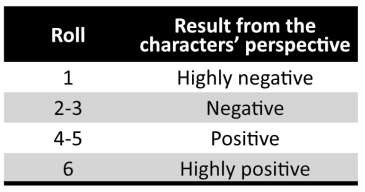
When running a d6-only hack of a hack of hack of OD&D, I went with a very basic bell curve:

Gave enough guidance on the outcome of an encounter without making me feel forced to follow any particular path. No ‘this pigeon attacks and fights to the death because the dice said so’, which I would absolutely feel compelled to do (not that that wouldn’t make for an interesting encounter, mind, but I feel it ought to be less likely than a dragon taking the same approach). Also meant I was rolling more reactions for undead which, especially considering we were playing through Barrowmaze, added some welcome variety.

To be honest, I feel we should throw into the mix whether we need all these ‘uncertain’ results on reactions tables. I’m rolling on the table because I’m uncertain what the outcome is - I don’t need the dice to shrug and go, “Yeah, I dunno either”!

5 Likes

Thanks for the replies both, and hey @Idle.Doodler - I played in a couple of sessions of your Barrowmaze game early on, before life intervened. I was playing a miner whose approach to most things was to dig a hole or otherwise build earthworks, if that sparks any memories. Enjoyed gaming with you!

2 Likes

Those reactions are just copied from the free OSE rules, but with a d6 table instead of 2d6.

Hah, I thought I’d seen that avatar pic somewhere before. Glad you’re still RPGing strong!

2 Likes

One thing to keep in mind is that in most presentations, a Character’s Charisma Score can influence Reaction Rolls.

This is bounded lower in B/X typically…the maximum bonus/malus are ±2. But a modifier of even these minor amounts on a d6 is quite powerful in terms of how it impacts Play. It only takes a CHA of 13 to never encounter those “Attacks” results again, and someone with a -1 penalty will never make friends :cry:

Since the triangular distribution of the 2d6 does a little more heavy lifting in terms of more likely and median results, this impact may not seem nearly as frequent of an occurrence.

Sure, it could be a flat d12 instead. It’s just whether we gain much from the triangular distribution.

It’s been noticeable for me over the decades :slight_smile:
The big thing is that procedurally I often have a few d6s handy (I need them to determine Encounter Distance, Surprise, Initiative, etc.) as part of the Encounter Sequence steps that occur prior to determining if a Reaction Roll will be necessary.

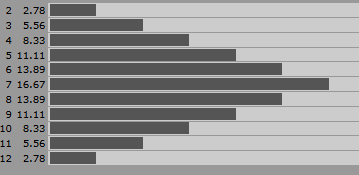
Someone better at probabilities might be able to chime in, but here’s how the typical Reaction Roll pans out on a 2d6:

So we’re dealing with only a 2.78% chance of those Extremes showing up. Immediately Hostile Encounters force the Players’ hands in a lot of ways, they take things like Parley and even sometimes Evasion off the table. Reaction Rolls are one of several gates that can prevent Combat from becoming a foregone conclusion in these games. Naturally this is prior to any circumstantial or Charisma modifiers that might be applied to the situation. Those have a large impact on triangular distribution within the context of the Reaction Roll potential results, which is one of the reasons why B/X keeps them low.

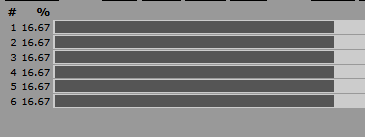
When we look at the Flat Distribution of just a single die, we can dive into the chances of those upper/lower bounds further:

Here those Hostile and Friendly result are an awfully lot more likely to show up in Play with a much greater frequency. Modifiers are still going to have a very large impact. It only takes one Hostile Encounter to prevent any further Encounters for a Party :wink:

1 Like

Another Fun Thing I often like to do is let Players roll their half of the 2d6 when it comes to those Reaction Rolls.

From the result of that single die, they can sometimes intuit the general tenor of an Encounter a little bit, and this might influence their Approach to the situation.

3 Likes

Ah yes, I see, so similar to B/X, that would make “indifferent” not neutral, but positive (hey, no attack…).

I’m mostly going by the OD&D method, which subsequent reaction rolls mostly subdivided to various degrees (BECMI to a rather ridiculous one, IMHO). In the very first RR table, we just had:

roll reaction percentage
2-5 negative reaction 27.78
6-8 uncertain reaction 44.45
9-12 positive reaction 27.78

Your 1d6 table would basically have an equal chance of each happening. Which certainly would impact the game, although that depends a lot on how often the table is used in the first place (IIRC OD&D disregarded it quite often), and how the values are interpreted. If you’re mostly doing unintelligent monsters, or are very harsh with negotiations…

Are we talking about the dice themselves, or the chances? I can map a normal distribution to a linear dice roll – easily done with a d00…

If so, the only “gain” I see right now would be the impact of bonuses. As @ktrey pointed out, a single +1 means a lot more on a 2d6 roll than a 1d12 one.

As I said above, I do like mods. Not that much of a fan of the Cha mod (or the stat in general, TBH), as in my mind the RR is often more a “first impression” roll, where you don’t really have that much chance to negotiate. If it’s uncertain/positive, then sure, the Cha 18 M-U might be able to have a large impact, but if we’re doing the cliche “party comes round corner, 6 orcs look surprised”, then I’d like to favor other circumstances. Especially if they involve a trade-off. I once had some good experiences with a “formation” modifier. Shields up, spears extended, etc. gave you both a -1 on the reaction rolls and a +1 on initiative (OD&D-ish setup).

I sometimes do more than one RR, and maybe that’s where one could do both things: A more chaotic linear roll for the first meeting, and a bell curve roll for the secondary request for information / trade roll. (Or go weird: You got an elf in the party? Linear rolls!)

Something else to consider is that reaction rolls are part of the entire encounter procedure in OD&D where they are introduced.

OD&D has rather dangerous surprise rules - in that monsters always have a 2 in 6 chance of surprise unless they are carrying light sources (and arguably even the human ones in the dungeon aren’t). Any monster with surprise automatically attacks.

Only after this check does the referee check reaction - so there’s an additional base 33% chance that the monsters attack with the advantage deadly advantage of surprise. PCs of course can also surprise, but only if they lack light sources and/or are barging into a room through a door (but even then all dungeon doors are stuck, meaning unless you succeed in unsticking them on the first try you lose that surprise chance…)

So in this context most monsters encountered on even terms are not immediately hostile… but a third of monsters are immediately hostile and have the drop on the PCs.

I’d also note that overall to be meaningful the reaction system needs to have a referee that doesn’t play up the friendliness of any result. Dungeon denizens are always jerks - and even if they don’t attack they may be demanding tribute, or not allowing the PCs to pass even if non-hostile.

2 Likes

This is very helpful context

Acknowledging that this topic is a couple weeks old, I wanted to add something that I didn’t see mentioned yet, because I love reaction rolls; they’re one of the most underrated tools for adjudicating games that involve exploration and faction interaction.

The bell curve means that players will often (but not always) have a relatively neutral interaction with an NPC or faction the first time. Sometimes the players will choose to steer it toward harmony or hostility, but the bell curve means that choice will often emerge from player choice rather than the dice. So the bell curve says “players, you will often get to choose how that first interaction goes.”

And the dice sometimes prompt me to think more deeply about an NPC/monster/faction when a roll surprises me; if a faction that is dangerous and threatening reacts to the PCs with guarded friendliness, that raises some interesting questions – are they more worried about something else? Do they want to leverage PCs against their enemies? Have they mistaken the PCs for someone else?

Then on subsequent encounters with the same person/group/creature, I would almost always apply a modifier (or not use a reaction roll at all if the output is obvious). This means that PC first impressions really drive the action in the scenario and the players have some time to think about how they want to position themselves vis-a-vis dungeon denizens. An NPC or monster attacking a PC (or on the other extreme, volunteering to join the party) the second time they meet the group is usually much more interesting than the same action taken on the first encounter.

3 Likes

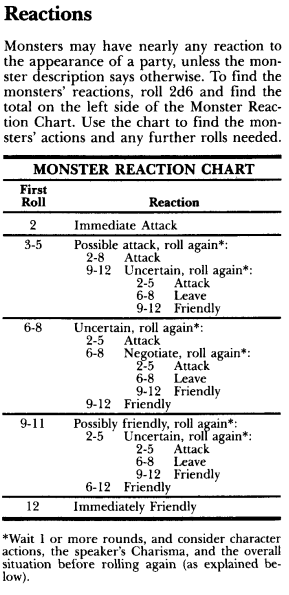
BECMI incorporates a kind of “Nested” Reaction Roll for this purpose. It’s rather ponderous, but it does actually create situations where the Reaction eventually sweetens or sours over time:

We used this version for quite some time, and it does give those Monsters a bit more depth in a way, creating some sometimes tense moments.

I’ll often tack on one of my Monster Miens as well, because that assists with the Portrayal a little :slight_smile: and I also devoted a small table to deal with those sometimes unexpected Friendly Results

1 Like

Interesting. I agree it would be a little ponderous, but I do like how it suggests reactions should evolve over time, which is the same idea myself and I’m sure others eventually got to by other means (a lot of trial and error).

And that mien table is great. I think I missed it when it was first published, but I found it more recently through your expanded dungeon stocking post calling back to that one and several others. So credit to you for coming up with a more elegant way to nest tables. :grinning_face_with_smiling_eyes:

1 Like