If players do the mapping at your table, what are some things that help it go smoothly?
Does the referee have ways of describing spaces, dimensions, or distances that are particularly clear? Stock phrases they use that are quick and clear?
When designing a dungeon map, are there things you tend to do or avoid to make the process of player mapping more straightforward?
How do you approach communicating map information for caves and natural caverns that adhere less strictly to the grid?
Biggest thing for me is picking one person to do the mapping and building a common language with them. I have a very nice silicone map that covers the table and has squares (or hexes) for whatever I need.
I don’t know how to answer the other questions though; I’ll pay attention in my next game to see what terms I use. “Square room, open/closed door, exits on the North and South side,” etc.
Having the same person map definitely helps build that common language. I run a Dolmenwood open table at a game cafe, so the players can vary each week.
I like the idea of using a larger mat so everyone can see it, rather than just graph paper that has to be passed around. Do you have a link to the type you use?
In an online play context, I am very close to scrapping player-mapping entirely.
I find the barrier between incorrect mapping caused by errors in player understanding and incorrect mapping caused by equally valid interpretations of genuinely vague descriptions I utter to be very thin.
The level of specificity (or post description clarification and reiteration) necessary to make player side mapping a genuine test of their attention to be a bit of a linguistic straight jacket. I’d much rather speak as evocatively as I can in the moment, then be permissive about differences between my blorb and the player’s mental picture.
I think for online games, I’m with you on ditching player mapping. For me at least, it feels more like a speed bump in that context than an aid to discovery.
And because digital tools often have a higher barrier to use than paper/pencil in person.
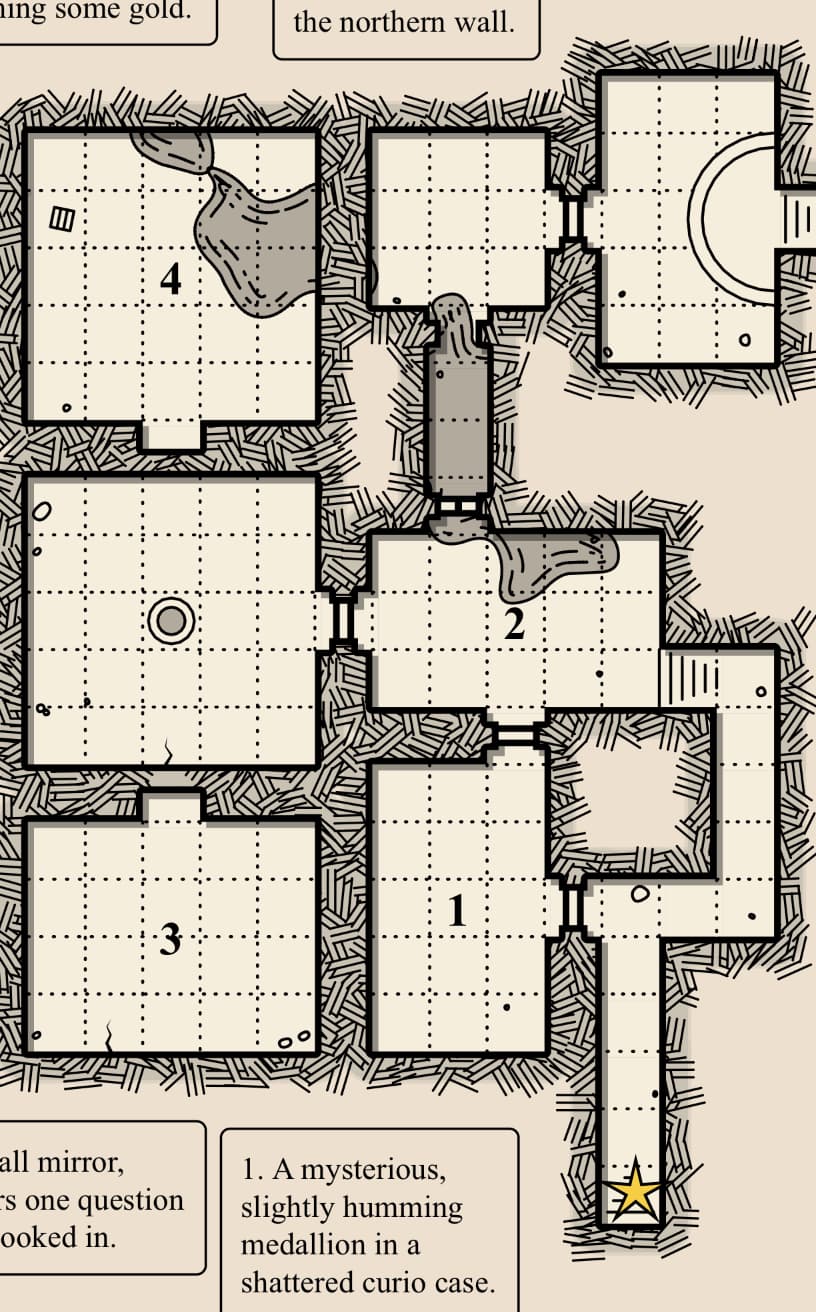
Here’s a good example of something I’d like to figure out how to describe easily and without much room for interpretive error.
If the PCs start at the star toward the bottom and make there way toward Room 2, I might say:
You enter the southernmost square of a 10 ft wide hallway that stretches 60 ft long, north to south.
At the northernmost square of this hallway, it opens both east and west. On the west side there is a door and on the east, the hallway continues for another 20 ft. where it opens up to the north.
The hallway continues north for 40 ft where it opens to the west.
Stairs lead upward for 10ft and then open into the southeastern square of a rectangular room.
It’s 50 ft east to west and 30 ft north to south.
The room has exits on the North, South, and West sides. The north exit is a double door in second square from the west. The south exit is a door in the center of that wall. The west exit is a door in the center of that wall.
I’m trying to think how any of this might be said more succinctly or be misinterpreted.
One big thing I like to stress to the Player performing Mapping duties is that trying to achieve strict fidelity and reproducing the Map I’m using isn’t really the primary goal of a Good Map.
To be a Good Map whatever they create really only needs to address two function:
It needs to tell us where we’ve been (so we know which areas we still need to explore)
It needs to tell us how the heck to get out of here (for when things inevitably go South!)
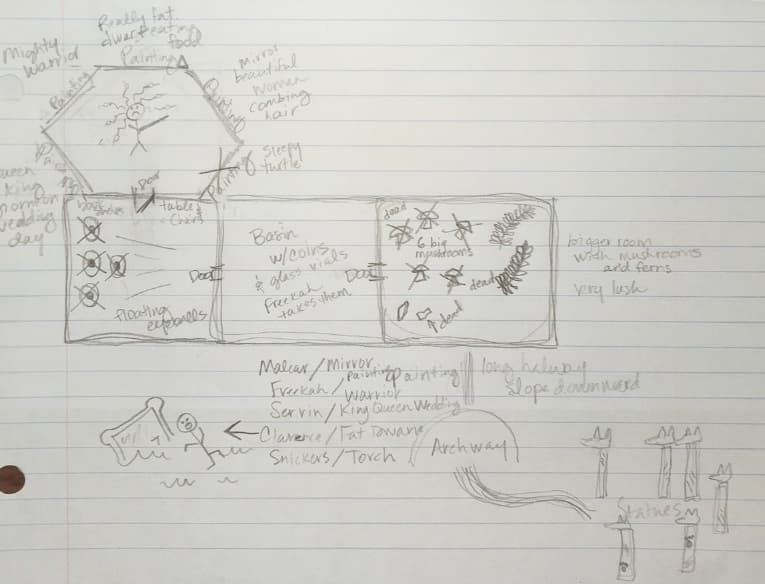
That’s really it. As long as it manages to achieve those two bullets, then the Map is going to be perfectly serviceable. Some Mappers prefer a more “flow chart” method of just shapes with a brief description (“Minotaur Statue Room” or “Place where we fought the Bugbears”) and lines to show interconnections/routes. These can work just fine for navigating the fictional space most of the time. Here’s an example:
I try not to get too hung up on providing precise measurements in Feet and such. I might use more “in world” measurements (torchlight, paces, within bowshot, longer than a pike’s length, etc.) if they really want to take the time to measure out a place for the purposes of solving a problem, but that comes with a cost (Time.) Not a lot of Adventurers bring Tape Measures with them after all! If an area is particularly tactically interesting or rich, and I want to make sure there are no misunderstandings, I’m perfectly content with sketching out an area for them really quick based on what they perceive (“The Lava Jets on the Floor are here, here, and, and here…next to this Crumbling Column here…” etc.) Glancing periodically at the Map they are making, and making suggestions/corrections based on things that would be obvious to an Adventurer in those spaces is a good habit to get into as well. I think this fosters a bit more competency and helps close those gaps much quicker than the table time it would take to correct an issue via Conversation alone.
Contemporary Play Culture and Dungeon Design relies a lot less of some of the “Mapping Minigame” tricks and cartographic elements. Older Dungeons would often reward diligent mapping with clues that might reveal things like Secret Areas (a noticeable lack of symmetry, or a big “blank area” could guide Searching somewhat) but this is far less common in Dungeons these days. The focus on Exploring the Space can be hampered sometimes by exiting the Fiction briefly when we are too focused on the back and forth that can develop with attempting to reconcile two Maps with precision.