Blog Book Club #42: A 16 HP Dragon

Welcome to this week’s blog book club. This week we are discussing A 16 HP Dragon by Sage LaTorra.

Edit: I was wrong Hosted by Sage LaTorra. Post by Stras Acimovic.

Next week we’ll be reading XP for Loot in D&D from Rambling Bumblers by Joshua Macy.

You can see a list of previous blog club posts here.


It all started with one small stat block for a very large and powerful creature.

While modern editions of D&D have dragons in the hundreds of hit points (256 for a adult red if we are splitting scales) , in basic D&D, a red dragon has 45 HP. The post explores the viability of the 16 HP dragon found in the Dungeon World book. In this post Stras explores why the combat in narrative fiction role games can feel so different than video games where you slowly shave off health consistently with a mob. While in the OSR we normally aren’t necessarily focused on genre emulation, in story games it takes center stage.
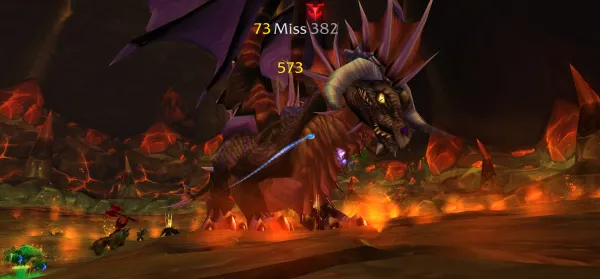
Source: Image from blog post by The Ancient Gaming Noob (game, Classic WoW)

I really enjoyed the flavorful description of the dragon encounter in this blog post and I think it contains several lessons for any system. The world reacts to character actions (like theft), the GM should show the impact of what monsters can do (and thereby telegraph danger), monsters should be proactive and not always wait in their caves, and smart monsters should attack the greatest threat to their lives without mercy. Finally, I believe that as a general rule of thumb the party should be allowed to run away from monsters (even flying ones that can cook them into toast).

Despite the entertaining read, I am not clamoring to go and run Dungeon World. I think simplicity does not mean the 16HP dragon is easy to run if you haven’t built up the necessary skills. My perception is that system mastery of this is on the GM knowing when not to call a roll, offering players very tough choices for mixed result rolls, and keeping the pressure on. For a well equipped party, the GM running the encounter likely needs to limit the players ability to gang up on a monster on the outset of the fight without it feeling like a punitive bloodbath.
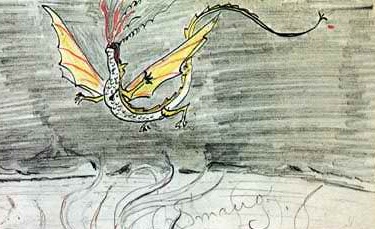
Source: Smaug Illustration by Tolkien

For as long as RPGs exist people will be chasing the vision of Smaug getting pierced by Bard’s arrow. Is this the full answer to that quest? For me, no. For some other folks, I think yes. A quick google search shows that people like discussing and wresting with the question of the 16HP dragon long after the popularity of Dungeon World crested. I think this post has a lot of implications on Into the Odd and Cairn play where monsters can make the equivalent of hard moves and HP is not as important as the fiction we create at our table.

What do you think?

2 Likes

A classic!

It is on Sage’s blog but it is quoting a post by Stras Acimovic

3 Likes

That was indeed a great read. Too bad the posts have dried up, but that can be the way of things. I like their idea of much more specialized magic items (soul piercing is soooo much better than + mechanics any day).

Still processing, but putting this out there for starters.

You know, I was thinking of The Shoeless Peasant while reading it and then saw you replying… :grin:

Like you were summoned…

1 Like

I’ve played a lot of Dungeon World, and I do get the impression that this post was extremely influential. I was a huge fan of the Discern Realities podcast (Jason Cordova / Gauntlet), and they brought it up fairly often, as a shorthand for the idea.

I love the idea in the abstract, and I think the blog had a very positive effect on how I run games (basically just training me to always focus on the fiction), but in practice I was always left feeling like I could not quite pull it off. For me, it came down to the numbers (such at HP) feeling more neutral. There’s a ton of wiggle room in the fiction, and making a harsh pronouncement as a GM would leave me feeling guilty. DW tries to balance this by one of the major mantras being “root for the players”. But the lack of objectivity in purely trusting the fiction was hard for me. That said, I think some GMs can absolutely pull it off, just not me.

Thank you! I’ve edited the post to reflect this.

I’m not a Dungeon Word fella either, though that sounds like a fun session. I am also in favor of having both more dragons and dragons as setting significant/powerful creatures.

To me the idea in this post (e.g. low HP and powers make for a better monster then a slab of high HP) is something that I think comes direct from OD&D or at least follows from its treatment of dragons. Dragons in OD&D have 5-12 HD and as little as 5HP (for a white dragon of the weakest kind and smallest size) and as many as 72 (The biggest ancient red dragon ever). Most will have around 30HP - around that of a 6 to 7th level fighter. They are dangerous because they can fly well, they have a breath weapon that does their HP in damage, have a good AC, are smart, and can sometimes cast spells. They are more a glass cannon monster then the other high level threats like giants or the terrifying Hydra - who are both much less versatile even if they have a lot more HP.

In general OD&D treats monsters like this - avoiding huge HP stacks (even with flat D6 damage) and using chainmail rules they can go down in a single hit I think (if one is very lucky … and of course so can everyone else). In general, depending less on mechanical combat and more on “fictional positioning” was I think an aspiration for mature OSR design, as it might be for a style that comes partially from trying to interpret older rules (including OD&D) from a perspective of making them work for adults in a post-VtM world where Storygames are a thing.

To me this all still speaks more of good adventure and setting design then pure referee skills, or at least that’s how these skills are taught. Your 16HP dragon is going to need to be described fully - both with its tactics and it’s goals and wants, weaknesses and fears … because otherwise things will just become a boring attritionary fight. This is partially because the other half of a dangerous but low HP monster is that the players are best served by schemes and set ups - traps, ambushes, tactics of all kinds. It’s sort of pointless to ambush a pile of danger that will blast everything in round two unless there’s a good chance of killing or disabling it in some way in round one. There are other solutions (HP and damage inflation with special abilities is pretty common), but most have serious effects on the overall power curve of the game.

2 Likes

Dungeon World as a whole (with the 16 HP dragon post as a part of that) has been hugely influential on how I GM combat in OSR games. I guess I might summarise it as a keen focus on what is actually happening in the fiction and not allowing mechanical simplification to rid that of its excitement and strategy. I try to approach combat as if it were any other RPG situation - describing the action, asking the players what they do, and then adjudicating the results.

Yes, there is a level of abstraction - we’re not practitioners of HEMA, we’re not interested in the blow by blow - and yes, we do rely on existing rulings rather than inventing the wheel every time. However, only as long as those rulings are preserving what is important, what we are interested in, at the current moment. If they are not, we make new ones.

For example, very few of my quadruped monsters walk up and start exchanging melee attacks. They charge, leap, try and knock down, and then spring away. If a golem hits a character squarely they are going flying and might end up on the floor. Beyond that, my homebrew system has wounds for big hits, players have to say how they dodge or block an attack, and much lower HP totals for players and monsters, as I have found all of those things keep us so much more grounded in the fiction.

(“I block the acid spit”. Uh huh - how?)

I believe this is not a popular approach in the OSR/NSR spaces; people tend to prefer “combat is an abstraction” (and sometimes use “combat as a fail state” to imply it doesn’t need to be fun). But this mindset has made the game so much more fun and engaging for us.

2 Likes

I recall reading an article in Dragon Magazine ages ago about using all of the aspects of a dragon in a fight. That resonated with me because I’d already taken to using some bits that weren’t simply abstraction and not in the MM. A tail swipe I treated as an area of effect and would knock PCs around while doing some damage. A maximum damage roll with a claw attack would knock the PC targeted around. The Dragon article included wing buffets and using wings to whip up clouds of dirt and grit; I don’t recall what else. (I’ll see if I can find it.)

[Edit]: Dragon issue #50, also reprinted in Best of Dragon #3. Self-Defense for Dragons. Advocated for 2 claw attacks, a bite, 2 wing buffets, 2 wing claw attacks, a foot stomp, and a tail swipe. With a breath weapon and overbearing rules, plus the flyby attack option, the dragons get a bit scarier.

That all made the dragons a bit more of a challenge in a fight and reflected the setting better, I reckon. That was long before the OSR appeared and I have to wonder why the OSR would drop that diagetic aspect of fights.

1 Like

The “XP for loot” blog club post gives us a clue, I think. The author very lucidly traces out a progression from dropping XP for gold, to emphasizing combat, to massively increasing options in combat (as well involving all classes equally, making it more survivable, etc.).

I agree that these things are contrary to the old school play. But given that the OSR was conceived in response to the problems of trad play (especially in the 3/4 edition period) I think that has given the OSR community a reflexive suspicion of anything that takes combat away from its old school, abstract roots - even if it’s not because combat is becoming the sole focus of play.

1 Like