Welcome to the blog book club. Today’s post is short and sweet. We’re reading the Pointcrawl Series Index, by Chris Kutalik of the Hill Cantons.
Next week, we’ll be back to the Necropraxis blog as Brendan S expands on overloaded encounter die with Hazard System v.02 .
We’ve already covered “Crawling without Hexes: the Pointcrawl” earlier in our blog book club. Kutalik would continue to iterate on point crawls through a variety of new terrains such as overland ruins and underground. I appreciate that these posts highlight some of the struggles of game design but also the persistence of designers.
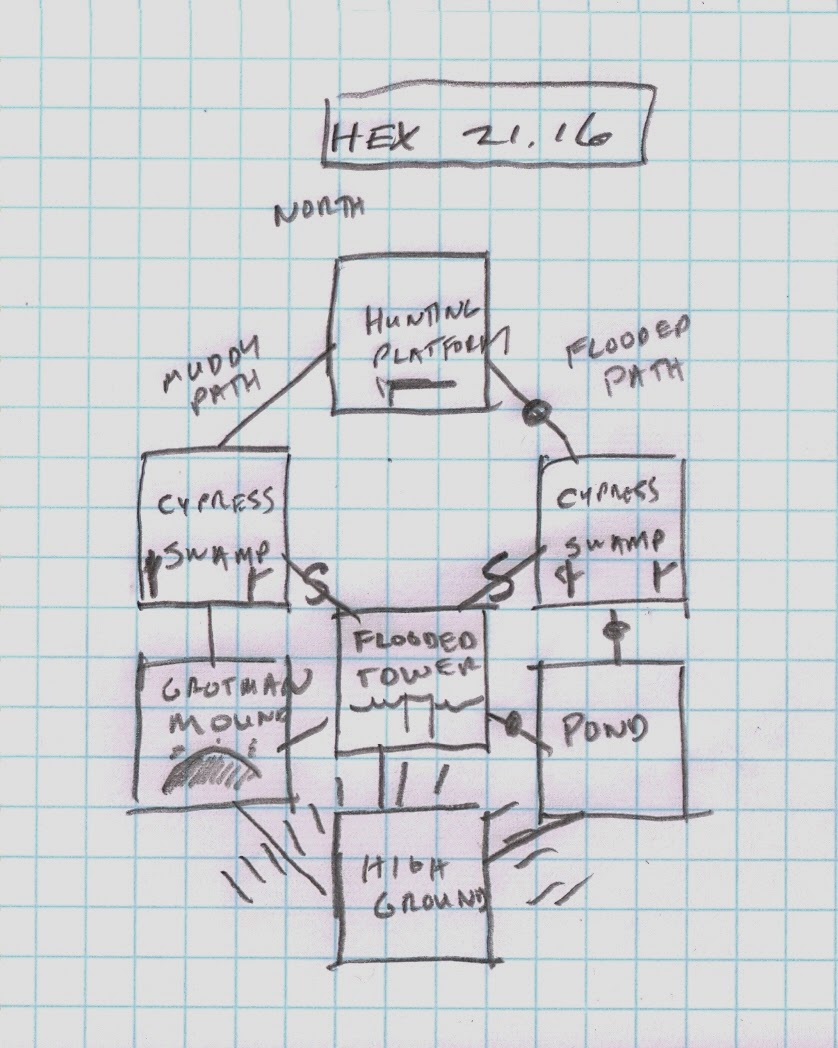
My favorite entry after the first is “Pointcrawling inside Hexes”. As many before me have noted 6 mile hexes are huge. Its also worth pointing out that Kutalik prefers a much more local focus on adventuring. His regional adventure setting “what ho, Frog demons!” has 2 mile hexes. Within these hexes they can be broken down into several points of interest. The post has a sample hex including 7 locations. While that might seem like a lot, I think sometimes we DMs fall into the trap of thinking that all areas need to be equally detailed instead of changing scale as the location demands.
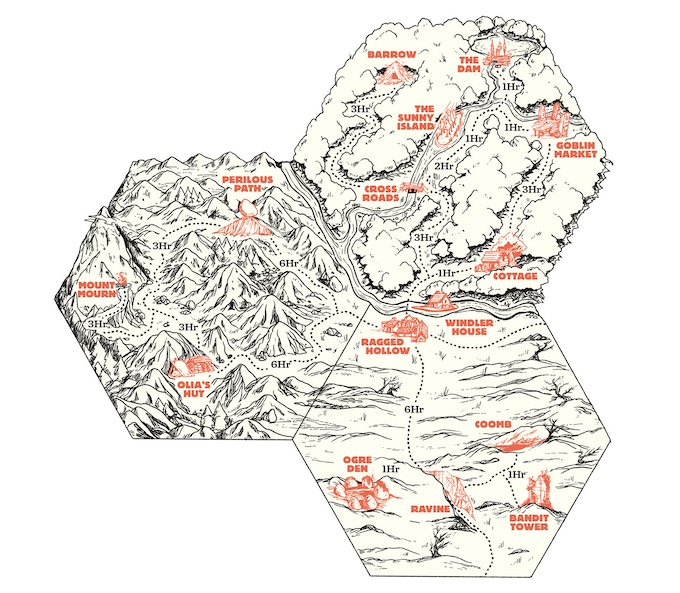
I’m reminded of Nightmare over Ragged Hollow as a best selling example of how this system might play out in a published module with the standard six mile hexes.
Bonus: While it breaks the timeline a bit I’d also point readers to Hexcrawls vs Pointcrawls which is not part of the index and it isn’t featured in the club list. I just find it to be a good continuation of the subject and helps explore the best times to utilize each mapping technique.
The more I play with them, the more I find the both of them, hexcrawl and pointcrawl, to be useful. I’ve been using hexcrawl rules with travel into unknown areas, whether traveling on roads and trails or simply trailblazing through rough. For those areas that are mapped, pointcrawling makes a good deal of sense and works to keep things moving.
I’ll note that I use random event checks even with pointcrawls to provide the sense of an active world. Wilds are wild and adventure can drop on travelers at any moment. When I first began using pointcrawls, the lack of random encounters annoyed me so I added those in and haven’t looked back.
I’ve been more ill than usual this week so I’m only now beginning to look at this and I’ve started reading through Chris’ posts. Perhaps more thoughts from me later.
I found Hill Cantons: Pointcrawling Undercities interesting - he describes breaking up a megadungeon into chunks (single page each) with point crawl links between them; some of the links have abstracted mazes to navigate.
This is close to something I’ve been wanting to put together. I was thinking of breaking up dungeons into even smaller chunks (sometimes, other times a full page) with lots of abstracted twisty areas and long walks in between, to really sell the idea of MEGAdungeon - huge underground spaces in which thousands of members of a faction can live.
I’d rather not get into OSR controversies here and distract from the conversation at hand. Feel free to DM me if searching the web doesn’t answer your questions.
Which I like. Obviously the maps in Nightmare over Ragged Hollow are beautiful and functional in a published product. But I could see myself jotting down a little diagram like this for a few hexes quite quickly.