From modules to sandbox campaign

I have been playing NSR style games for a while (Mothership, Odd-like games), always with the adventures beign kind of disconnected in time and used almost like in a bubble.

Recently I started looking more closely into Old-School retroclone style of games and I have read a few adventure modules. I am wondering now how I would go about making a campaign in which the choice of adventure and action is left to the players, a sandbox campaign.

Of course, there are a multitude of products that offer a sandbox hexcrawl (Gods of the forbidden north seems really cool) but I am assuming the easiest thing to do is to follow some sort of pointcrawl, as it simplifies choice and presents a conceptual “point and click” for zooming in.

Now, with the OSE/BX ruleset in hand and a bunch of compatible adventures, how do you go from the set of modules to the sandbox campaign? Some other subquestions are

  • What do I miss if I use a pointcrawl instead of a hexcrawl?
    • What would be the gamefeel from the players navigating a hexmap?
  • How do I populate a world/map properly from the modules?
  • How can we cast the sense of exploration into a pointcrawl?
  • What about random encounters in travelling?

I assume this is a large discussion to be had, but I would appreciate experiences and insights about the topic.

In any case, I am happy to take a look at blogs if there are some interesting references that actually point to this kind of question.

Cheers

1 Like

I think it’s important to mention that the Hex-Crawl/Point-Crawl approaches aren’t mutually exclusive: Both methods provide different benefits/drawbacks and they can also work in conjunction with each other.

I like Hex Maps to provide me, as a Referee, with that “Bird’s Eye View.” They can help me understand the Biomes/Terrain/Environments being explored, and the Relationships of Important Features with each other. The Hexes can serve as Containers for Stocking Purposes, identify specific Regions that share Encounter Tables/other Features, or work like “Rulers” for me to quickly adjudicate/estimate Distances/Time for providing things like Directions or Rumors.

The Hex Map in my games isn’t really Player Facing though, it’s just a tool for me to help adjudicate that Overland Travel. Players might receive or acquire more “In World” Maps, but I don’t really portray the Wilderness to them in terms of those “Hexes.” Providing the Hexes can sometimes influence decision making in strange ways I’ve found: Many Players assume that once a Hex is “Traversed” it’s been dealt with, or they may use it to directly gauge Decision making like Supply Requirements/Travel Times…taking some of the Mystery and sense of Adventure out of Wilderness Exploration and Discovery.

Travel Overland is always going to take place on Paths of some sort: You don’t walk directly through a Lake without the aid of Magic, so you circumnavigate via the Shoreline. A Formidable Mountain Range might require locating a suitable Pass or Switchbacks. The key thing I try to remind myself about is that Travel is seldom in those straight-lines as the Gryphon flies. Even Roads/Rivers can wind and wend. These can either be explicitly mapped out or handled more abstractly. With the Wilderness Exploration Procedures I tend to use, we don’t usually try to granularly represent every footfall or moment of Travel. We focus more on the Decision Points/Choices, Encounters, and Features/Discoveries made along the way. In some ways these are a bit like the “Points” in a Point-Crawl.

In terms of “Stocking” Hexes I do have a document that explains my Process Hex Stocking Example that includes some examples and links to several of my Resources. When it comes to Placing a pre-existing Module/Dungeon within, I simply choose a suitable location based on the Terrain/Surrounds usually. If the Module references a Settlement, I might substitute that or place it on the Map as well.

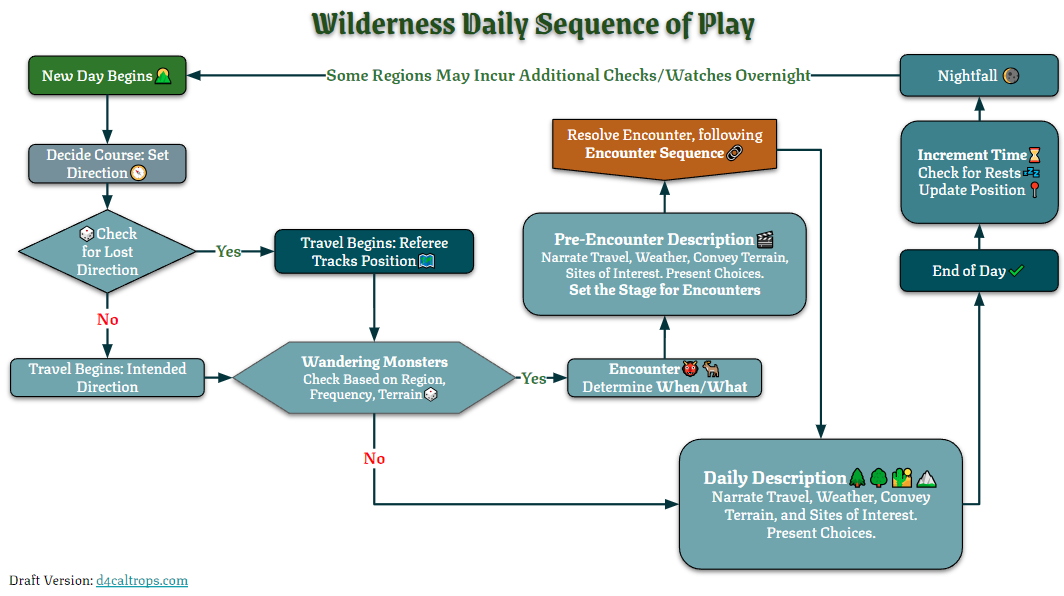
Wilderness Exploration does benefit a bit from Procedures I’ve found: Random Encounter Frequency is part of this. The Basic “B/X Framework” is a pretty good skeleton for this to flesh-out:

You may find that you want to handle things at a different level of granularity (Watches instead of Days, Weeks instead for longer journeys, etc.) but the basic framework helps insure that none of the necessary “steps” are skipped, Procedural Checks are made as appropriate, and Resource Depletion isn’t overlooked.
3 Likes

I am still learning how to improve the way I run sandboxes. In the past I have run a large premade sandbox seeded with D&D adventures from my favorite indie authors. My main advice is to figure out what you want the focus of the campaign to be. The more involved the system of environmental exploration is, the less time there will be for other modes of play.

Simple vs complex. I have witnessed across a variety of blogs that there are ways to create incredibly simple hexcrawls and highly complex point crawls. The complexity level isn’t the visualization system itself, but how many choices you are putting before a players at each juncture, what information you have given the players to make decisions about navigating their environment, and the role of the environment is intended to play in the campaign (e.g. framing device, obstacle, puzzle, drain of resources, antagonist). The level of abstraction during travel has a large impact on how much of your sessions environmental exploration will consume. Figure out whether spending an entire session interacting with this system would be satisfying or vexing for you and your players. Or conversely, will they complain if the map is too simplified and ‘game-y’?

Another question is whether your players are interested in exploring and discovery for their own sake. Will they climb the mountain billowing smoke because its there? Or will they need to be motivated by rumors, hooks, or patrons? This can impact how you prepare your game.

Discovering your preferred mode of play by trying out smaller regional scale adventures might be worthwhile. The works of Lazy Litch or Jacob Fleming contain examples of hex crawls which could be expanded either by placing additional dungeons within their confines or by linking them to other modules and expanding the map. Other people still use Mystara, Greyhawk, and the Wilderness Survival game map and place pre-written adventures wherever they deem appropriate. For other GMs, authorship over their campaign world is important and they use products like Worlds Without Number, d30 sandbox companion, or the Tome of World building to design sandboxes.

If point crawls seem more interesting to you, try a point crawl adventure like Slumbering Ursine Dunes or one of the newer first party Cairn Adventures. Adventures designed as hex crawls can be translated into point crawls if you are willing to put in some work. My friend Derek details the process of how he turned Black Wyrm of Brandonsford into a point crawl in his blog series. He would argue that if set up correctly, a point crawl can do all the things a hex crawl can do. What Makes A Good Player-Facing Pointcrawl? | Widdershins Wanderings

3 Likes

There is already amazing advice in this thread, but I wrote a post series on just this topic not too long ago if you want to check it out. The Overachiever’s Guide to Lazy Hexcrawl Building. – Revivify Games

I run my hexcrawls like a point crawl. The hexes around the points are alternate paths of travel, future adventure locations, and an opportunity to tax resources through random encounters or reward curiosity. If you don’t want to “fill the gaps” between the main points of interest in your campaign, then I think you probably should just run a point crawl. Personally, I hold on to a couple of small dungeons or towns that aren’t really part of the campaign and will drop them when the players decide to go exploring. It’s a great way to build an emergent story.

2 Likes